
Hanoi is one of those cities that feels completely different depending on where you base yourself. I’ve stayed in two very different parts of this city: a month in Ba Đình, and a stretch in Tây Hồ. Completely different experience.
This guide isn’t about finding the most Instagrammable hotel. It’s about helping you figure out which part of Hanoi actually suits how you travel, whether you’re here for five days or five weeks, whether you want to be in the middle of everything or slightly removed from it.
Quick answer: first-timers, Old Quarter. Long stays or slow travel, Ba Đình. Digital nomads wanting space, Tây Hồ. The full breakdown is below.
Best place to stay in Hanoi: Quick Comparison
| Neighborhood | Official District | Best For | Downside | Recommended Stay |
|---|---|---|---|---|
| Old Quarter | Hoàn Kiếm | First-time visitors, short stays | Noisy, touristy, little breathing room after a few days | The Oriental Jade Hotel |
| French Quarter | Hoàn Kiếm | Couples, museum-goers, shorter trips | Can feel detached from the real Hanoi energy | Anatole Hotel Hanoi |
| Ba Đình | Ba Đình | Slow travelers, longer stays, wanting a local feel | Less convenient for nightlife and sightseeing | Aira Boutique Hotel & Spa |
| Tây Hồ | Tây Hồ | Digital nomads, families, repeat visitors | Feels removed from the city culturally | An Naguyen Lakeside Residence |
How Hanoi is Actually Laid Out
Hanoi has 30 official districts. For visitors, most of them are irrelevant.
The area you will spend most of your time sits across a handful of inner urban districts clustered around the Old Quarter and West Lake.
Hoàn Kiếm is the oldest and smallest district. The Old Quarter sits in its northern half – 36 streets originally organized by trade guild, each named for what was sold there: silk, paper, bamboo, tin. Some still carry the same trade today. The southern half of Hoàn Kiếm is where the French built their administrative center during colonial rule – wide boulevards, the Opera House, government buildings, Hoa Lo Prison. Visitors call it the “French Quarter” but it has no official designation. It’s still Hoàn Kiếm, just a different side of it.
Ba Đình sits just west of the Old Quarter and has always been the seat of power. The Thăng Long Imperial Citadel was built here in the 11th century. The French later made it the center of their colonial administration. And on September 2, 1945, Ho Chi Minh stood in Ba Đình Square and declared independence from French rule. Today it’s where the government ministries, foreign embassies, and the Ho Chi Minh Mausoleum all sit. Wide planned boulevards, protected from commercial redevelopment – it looks and feels like a capital city.
Tây Hồ is the youngest of the main districts, established in 1995 to manage the growing area around West Lake. It’s Hanoi’s least densely populated inner district, which explains the breathing room. The expat community here is well-established – international restaurants, French bakeries, lakeside cafés. Trúc Bạch, the small lake that sits between Tây Hồ and the Old Quarter, is technically within Tây Hồ’s boundaries but feels like its own pocket of the city.
💡Looking for the best deal on hotels in Hanoi? I recommend checking across a few platforms before booking. Booking.com, Trip.com and Agoda are the three I always cross-reference for Southeast Asia.
Hoàn Kiếm District
Hoàn Kiếm is the smallest district in Hanoi and the most densely packed – around 35,000 people per square kilometer before you add the tourists. It’s divided into two very different halves.
1. The Old Quarter
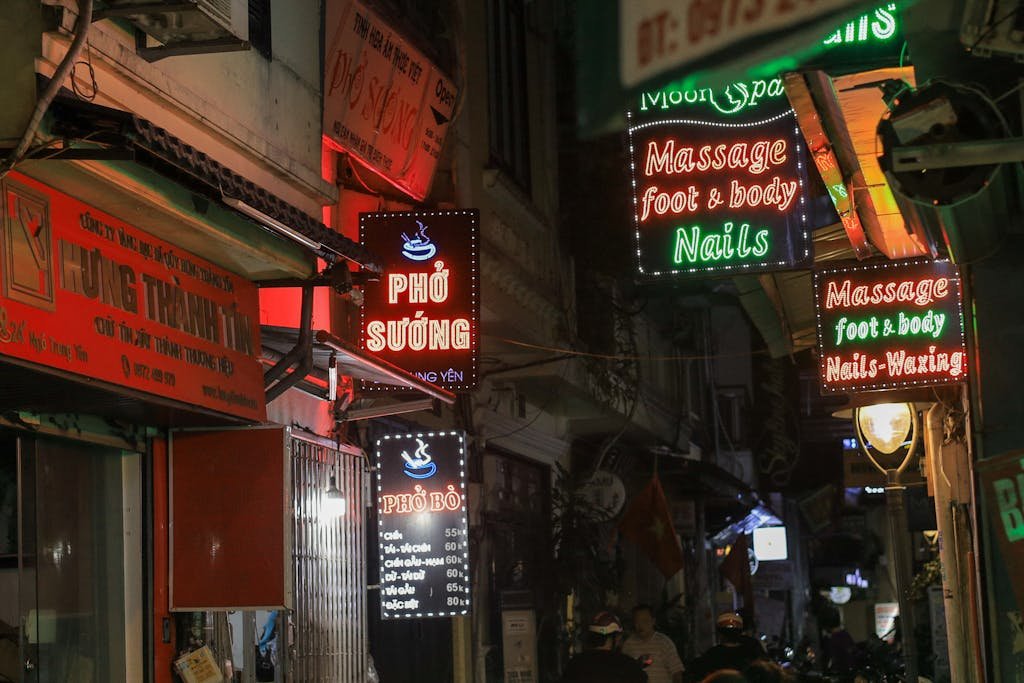
The Old Quarter is the northern half of Hoàn Kiếm, and it is a lot. Narrow streets, scooters coming from every direction, the smell of grilled meat mixing with exhaust, tiny plastic stools spilling onto pavements, shop fronts stacked floor to ceiling. The 36 streets still carry the names of the guilds that once traded there – Hàng Bạc for silver, Hàng Gai for silk, Hàng Mã for paper goods. Some still sell exactly what the name says.
Hoàn Kiếm Lake anchors the southern edge of the quarter. Walking it at night, when the surrounding streets close to traffic and locals come out to sit, cycle, and people-watch, is one of the better free things you can do in this city.
Tạ Hiện Street (beer street) is a popular one. It’s loud, it’s chaotic, it’s wall-to-wall beer and people watching from low stools. If you’ve read about train street, that’s also in this neighborhood.
For something quieter, Little Shelter, Moon Men, Rabbit Habit, and Black Sheep are all bars I enjoyed.
Where to Stay in the Old Quarter
The Oriental Jade Hotel | One of the better luxury options in the Old Quarter if you want to be central without feeling trapped inside beer street chaos 24/7.
La Siesta Classic Ma May | A boutique heritage-style hotel right in the middle of the Old Quarter, walkable to basically everything, but still surprisingly calm.
Hanoi Allure Hotel | A more affordable serviced-apartment-style stay that works well if you want extra space without losing access to the energy of the neighborhood.
The French Quarter
South of Hoàn Kiếm Lake, the city changes. The streets widen and the buildings get taller. This is where the French built their administrative capital during colonial rule, and the architecture makes that history impossible to ignore – the Opera House modelled on the Palais Garnier, the Sofitel Metropole where the guest list once included Charlie Chaplin, the old Indochina government buildings that now house ministries and museums.
Hoa Lo Prison sits here too. Built by the French in 1896 to hold Vietnamese political prisoners, was subsequently used by North Vietnam to house U.S. prisoners of war (POWs) during the Vietnam War. American POWs nicknamed it the “Hanoi Hilton”. It’s definitely worth a few hours of your time.
The pace in this part of Hoàn Kiếm is slower than the Old Quarter. Fewer vendors, wider pavements, more shade. It works well for a shorter trip built around museums and architecture. The tradeoff is that it can feel slightly removed from the parts of Hanoi that actually feel alive.
Where to Stay in the French Quarter
Sofitel Legend Metropole Hanoi | The classic French colonial luxury hotel in Hanoi.
Anatole Hotel Hanoi | Smaller and more intimate than the major luxury hotels nearby, with a quieter location that still keeps you close to museums, cafés, and Hoàn Kiếm Lake.
Somerset Grand Hanoi | A solid serviced apartment option if you want the French Quarter location but need more room, especially for longer stays or remote work.
Ba Đình District
Ba Đình is quieter than the Old Quarter. It feels more residential, more local, less curated.
It’s also the political and historical heart of Hanoi. Ba Đình Square is where Ho Chi Minh declared independence from French colonial rule in 1945. The Mausoleum, the Presidential Palace, the One Pillar Pagoda – they’re all here, sitting alongside embassies and government ministries on wide, tree-lined boulevards that feel distinctly different from the tangle of the Old Quarter.
What doesn’t make it into most guides is the quieter side of the district. Hồ Đầm Tròn, a small lake tucked into the residential streets, is the kind of place where mornings actually feel like mornings. And Cộng Cà Phê – if you haven’t been, it’s a Vietnamese chain but a good one, done up in faded socialist-era aesthetics, strong cà phê trứng, reliable wifi. Good place to work from for a few hours without feeling like you’re in a tourist café.
The B-52 wreckage in Hữu Tiệp Lake is worth mentioning too. The remains of an American bomber shot down in 1972 still sit partially submerged in a small residential lake, surrounded by houses and laundry lines.
Ba Đình works best for longer stays. It’s less convenient if you want to walk everywhere from one base – some sights require a short Grab ride – and nightlife options are limited.
Where to Stay in Ba Đình
Lotte Hotel Hanoi | One of the more polished stays in Ba Đình. Good views and connected to local neighborhoods.
The Five Residences Hanoi | Serviced apartment setup for longer stays, remote work, or anyone who wants a kitchen.
Aira Boutique Hanoi Hotel & Spa | Boutique hotel near the edge of Ba Đình, great central location.
Tây Hồ District – West Lake
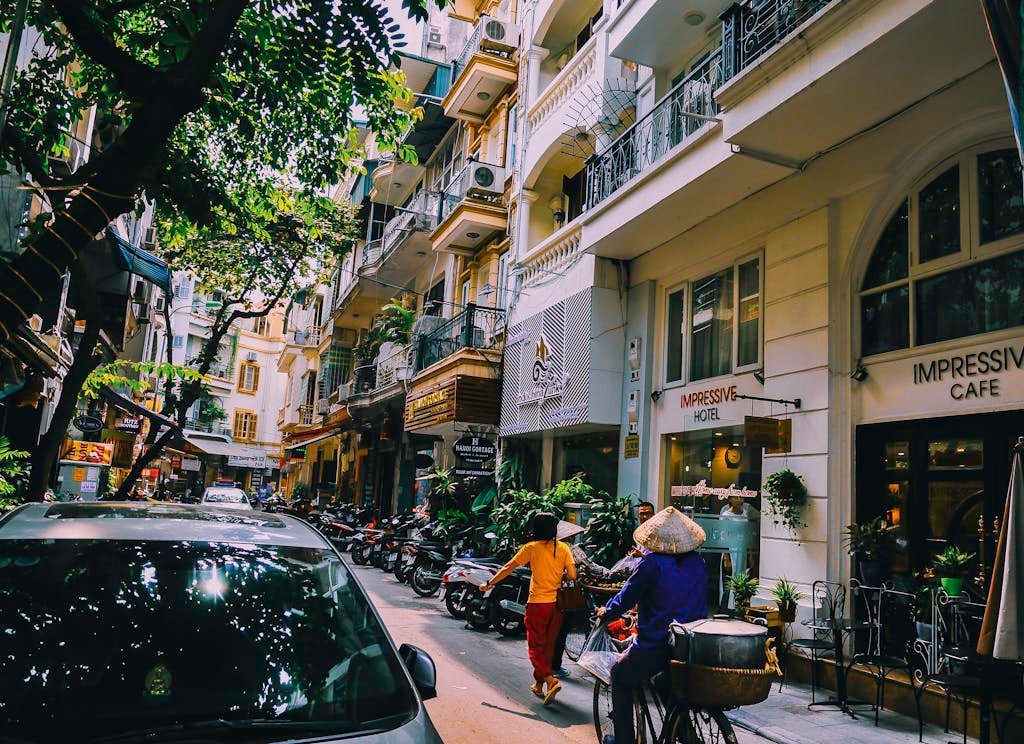
Tây Hồ is Hanoi’s most developed inner district, and it feels like it. Wide streets, international restaurants, French bakeries, wine bars, lakeside cafés with reliable wifi. The expat presence is heavy and visible – this is where the digital nomads, the long-term residents, and the foreign embassy crowd all end up.
It’s very gentrified. More English spoken, more familiar conveniences, more of a sense that the neighborhood has been built around a certain kind of resident. Depending on what you’re looking for, that’s either exactly the point or exactly the problem.
West Lake itself – Hồ Tây – is the largest lake in Hanoi, and the district is built around it. Trúc Bạch Lake sits at its southern edge, marking the transition toward the Old Quarter. The streets along the water, particularly Xuân Diệu and Tô Ngọc Vân, are where most of the activity is concentrated – restaurants, boutiques, the kind of café you can sit in for four hours without anyone moving you on.
Culturally, it’s the furthest you’ll feel from the Hanoi of the Old Quarter. That’s a real tradeoff for a first visit. But for a longer stay – anything over two weeks – it’s easier to build a routine here. Easier to find a gym, a community, a regular spot. The infrastructure supports that kind of living in a way that Ba Đình and the Old Quarter don’t quite match.
Where to Stay in Tây Hồ
An Nguyen Lakeside Residence | The classic Tây Hồ luxury stay, built directly over the water with genuinely great lake views.
Oakwood Residence Hanoi | Great for longer stays, especially if you want apartment-style living, gym access, and other amenities.
Elegant Suites Westlake | Serviced apartment option near Xuân Diệu.

🛂 Pakistani passport holders can enter Vietnam on an e-visa. I’ve also mapped out visa requirements for every other country, including e-visa, visa-on-arrival, and visa-free destinations, plus what you unlock with a US, UK, Canadian, or Schengen visa. Check the visa tool!
Hai Bà Trưng District
Hai Bà Trưng sits south of Hoàn Kiếm and doesn’t get much attention from visitors. It’s one of Hanoi’s more densely populated districts, with a commercial and residential mix that feels distinctly local. Vincom Center Bà Triệu, one of the city’s larger malls, is here. So is Thống Nhất Park, a large green space that’s popular with locals for morning exercise and weekend picnics.
It’s not a base most visitors would choose, but if you’re in Hanoi for an extended period and want something genuinely off the tourist trail, it’s worth knowing about.
Đống Đa District
Đống Đa is where Hanoi’s universities and cultural institutions cluster. The Temple of Literature – Văn Miếu – sits here, built in 1070 as Vietnam’s first university and dedicated to Confucius. It’s one of the best-preserved historical sites in the city and worth a half day.
The district itself is residential and busy, home to colleges, hospitals, and the kind of everyday Hanoi that doesn’t make it into travel guides. Not somewhere most visitors stay, but the Temple of Literature alone makes it worth the Grab ride.
🚗 Heading south after Hanoi?
Central Vietnam feels completely different from Hanoi. The pace slows down and you trade scooters and dense alleyways for beaches and longer coastal stretches. If you’re continuing south, these guides on the best beaches in Da Nang, what to actually do in Da Nang, and planning the route from Da Nang to Hue will help you figure out the next part of the trip.
So, Where Should You Stay in Hanoi?
It depends on what kind of trip you’re actually taking. First visit, limited time: stay in the Old Quarter. The noise and the density are the point. You want to be inside it, not commuting to it every day.
Longer stay, more than a week: look at Ba Đình. It’s quieter, more residential, and it doesn’t wear on you the way the Old Quarter does after a few days. You’re still close to everything that matters but you’re not living inside a tourist center. It’s where I’d go back to.
Digital nomad or extended remote work trip: Tây Hồ makes the most practical sense. The infrastructure is there, the community is there, and West Lake is genuinely a nice place to spend a morning.
One thing worth saying plainly: a lot of people book the Old Quarter because that’s what every guide recommends, and then spend half their trip exhausted by it. Think about your pace before you book, not after.
Hanoi is one stop on a longer Vietnam route for most people. If you’re still figuring out the rest of the trip, the Vietnam travel itinerary is a good next step.
