
Montenegro was supposed to be a beach trip. That’s the whole reason people go, isn’t it? All that blue Adriatic water, boats bobbing around Kotor Bay, everyone posting the same three photos from Budva. But apparently I’m physically incapable of visiting a country without also going and finding its mountains, so we built a few days in Durmitor National Park into what was otherwise a pretty standard road trip around Montenegro.
Durmitor is Montenegro’s alpine side, and it barely gets mentioned next to the coast. It has glacial lakes, a canyon that’s the second deepest in the world, and a small town, Žabljak, that somehow still feels more like a place people live than a place built for tourists. We only had time for the basics, Black Lake, a few viewpoints, the drive in, and it was still enough for me to get my mountain fix.
Here’s everything I’d tell you before you go: what’s actually worth doing, how many days you need, and how to get yourself there without losing half a day to logistics.
Where Is Durmitor National Park?
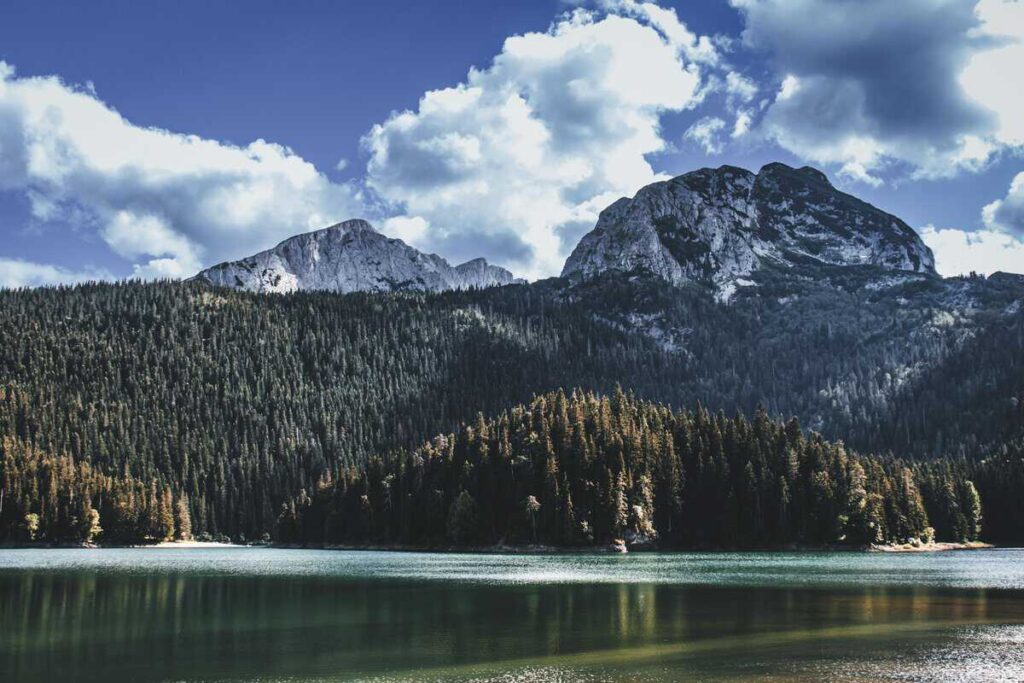
Durmitor National Park sits in the northwest of Montenegro, part of the Dinaric Alps, roughly 2 to 3 hours from the coast depending on where you’re starting. It was established back in 1952 and became a UNESCO World Heritage Site in 1980. The whole protected area covers about 390 sq km (~150 sq m). That’s not a huge number on paper, but almost all of it is genuinely wild: pine forest, karst rock, and close to 50 peaks over 2,000 metres, packed tightly together.
The landscape was shaped by glaciers, rivers, and underground streams, and it’s home to an unusually rich mix of endemic plant life for an area this size. You don’t need to care about botany to notice it. It shows up as dense black pine forest one minute and bare limestone the next, sometimes within the same drive.
Then there’s Tara River Canyon, cutting straight through the middle of the park. At around 80km (50 miles) long and 1,300 metres deep, it’s the deepest gorge in Europe. Žabljak is your base for all of it, and at 1,450 metres, it’s the highest town in the Balkans. It’s small enough to walk end to end, and close enough to Black Lake that you don’t need a car just to see the park’s most famous view.
One more thing worth knowing before you go: Montenegro’s own name comes from this terrain. It’s the Venetian version of “Monte Negro,” Black Mountain, and Durmitor’s dark, jagged peaks are a big part of why.
Best Things to Do in Durmitor National Park
Durmitor rewards pretty much every kind of traveller. If you want a full day of driving through landscapes that don’t look like they belong in Europe, there’s the Ring. If you want a hike that’ll wreck your legs by the top, there’s Bobotov Kuk. If you just want to sit by a lake and do absolutely nothing, Black Lake will let you get away with that too.
Hiking & Trekking
Durmitor won’t make anyone’s list of the world’s great trekking destinations, but the trails here are rugged, and the views earn the effort. Not everything below is something we hiked ourselves.
Crno Jezero (Black Lake)
We walked the full 3.5km loop, and it’s genuinely the easiest, most rewarding couple of hours you’ll spend in the park. Pine forest all the way round, sharp peaks behind it, and a lakeside café if you want a coffee to go.
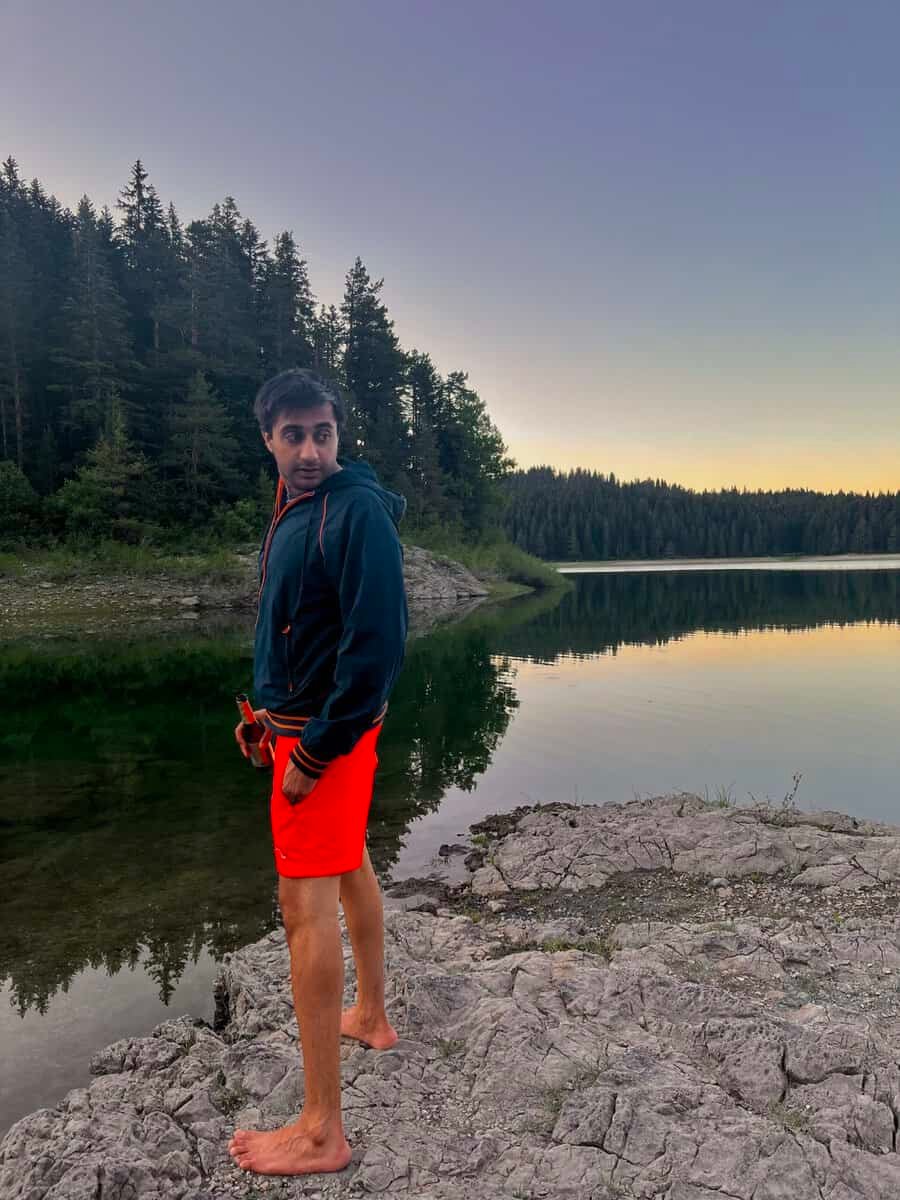
We came back after the loop and just stayed. Sat by the water well into the night and ended up watching the Milky Way over the lake, properly visible in a way you never get on the coast with all that light pollution. If you only do one thing in Durmitor after dark, make it this one.
Difficulty: Easy
Distance: 3.5km loop
Time: 1-2 hours (longer if you stay for the stars, which you should)
Starting point: A short walk from Žabljak
Bobotov Kuk (2,523m)
If you only do one hike in Durmitor, make it Bobotov Kuk. Standing at 2,523m (8,278 ft), it’s the highest peak in the park and offers jaw-dropping views of the entire Durmitor massif, stretching out like a sea of jagged limestone waves. The hike up is a solid challenge, with steep, rocky sections and some scrambling required near the summit. The trail is well-marked but steep, so starting early is a good idea to avoid the midday heat.
Difficulty: Hard
Distance: ~10km round trip
Time: 5-6 hours
Starting point: Sedlo Pass, about 30 minutes from Žabljak
Route: You can follow the map on All Trails
Ledena Pećina (Ice Cave)
It’s a glacier cave with ice formations that reportedly hold year-round, even mid-summer, which is the whole appeal. The trail starts near the Katun Lokvice shepherd huts, reachable from Black Lake with some extra walking.
Difficulty: Moderate
Distance: 8 km round trip
Time: 4-5 hours
Route: You can follow the map on All Trails. The trail begins near the Katun Lokvice shepherd huts, which can be reached from Black Lake with an additional hike. The path is marked but can be rocky, so good footwear is a must.
Skrka Lakes Valley
It’s two alpine lakes, further out and quieter than Black Lake, and it’s really a full extra day, which we didn’t have this trip. Starts from Dobri Do Valley.
Difficulty: Moderate
Distance: ~12 km round trip
Time: 5-6 hours
Starting point: The trail starts from Dobri Do Valley, accessible by car from Žabljak. The route passes through high mountain terrain, so expect some elevation gain and rocky paths.
Durmitor Ring Scenic Drive
Clear an entire day for this one. The Ring is a 76km loop through some of Montenegro’s most remote and dramatic landscapes. It starts and ends in Žabljak, winding through high-altitude passes, deep gorges, and remote villages.
The road is mostly paved but narrow and steep in places. A full loop takes about 4–5 hours without stops, but realistically, you’ll want to take your time because nearly every turn demands a photo.
What you’ll pass along the way:
- Ćurevac – a short detour off the main loop (about 3.5km one way). You get a proper view down into Tara Canyon from either the parking lot or a short hike up to the peak.
- Crvena Greda – a viewpoint further along, often paired with a stop at a small mountain restaurant with an old, abandoned ski lift still standing nearby.
- Mala Crna Gora and Pišče – a couple of tiny villages along the route. Not much to “do” here, but worth slowing down for. Chalet-style houses, livestock everywhere, the kind of place that gets properly cut off once the snow sets in.
- Sušica Canyon – a second, smaller canyon on the route, with a steep, hairpin-heavy descent down to the valley floor. There’s a lake down there in theory. We were there in summer, when it usually dries up, so don’t count on seeing water.
- Trsa – where we stopped, roughly the halfway point of the loop. A church, a handful of houses, and enough of a break to remind you people actually live out here full-time.
- Prutaš Peak viewpoint – the rock formations here run in visible horizontal layers, like the whole mountain got folded sideways at some point. One of the more dramatic stops if you’re doing the full loop.
- Sedlo Pass – the highest paved road in Montenegro, and also the trailhead for Bobotov Kuk if you’re hiking. You’ll feel the altitude here even from the car.
- Pošćenska Dolina Valley – the last real stop before the road drops back toward Žabljak, with a few small seasonal lakes visible from the road.
One thing I’ll say straight: we rented a Mini Cooper convertible for this trip, and it was a bad call. You don’t need a 4×4, the road’s paved the whole way, but you do need something with real ground clearance and enough weight to handle steep inclines with no guardrails. A convertible is not that car.
🚗 When comparing rental prices, I usually check Discover Cars first since it aggregates different companies and sometimes ends up cheaper than booking directly.
Tips for Driving the Durmitor Ring:
- Start early to avoid midday heat and tour groups.
- No gas stations on the route, so fill up before leaving Žabljak.
- Plan for stops – there are no tourist facilities along the way, just raw, untamed nature.
- Rangers sometimes collect a €5/day park entrance fee at the parking lots along the way, so keep cash on you.
- Safe driving window is late May through October, the high passes shut down completely in winter.

Tara River Canyon
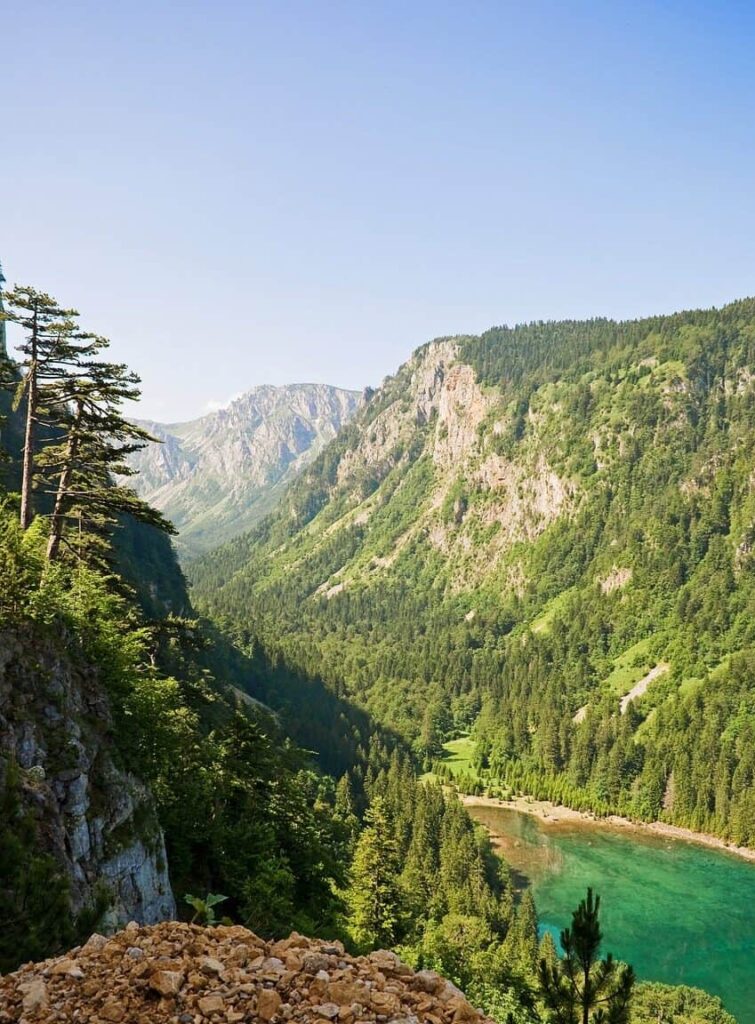
The canyon cuts straight through the park, limestone cliffs dropping over 1,300 metres to the river below. It’s the deepest gorge in Europe.
White-Water Rafting
We ran out of time for this, which I regret, since it’s probably the single most-recommended thing to do here. Neither of us has rafted the Tara, so consider this the research version, not the lived one.
The standard one-day route runs from Brštanovica to Šćepan Polje, roughly 18km, taking about 3 to 4 hours and covering somewhere around 20 rapids. Difficulty sits between Class 3 and Class 5 depending on the season.
May and June bring the highest water levels and the roughest ride, best suited to people who actually want the adrenaline. By July through September, the water calms down considerably, which is when most operators start recommending it for families and first-timers.
🛶 Book it: If you want to raft the Tara without renting your own gear or figuring out logistics, a full-day group tour with pickup, food, and a skipper runs around €137.
Want to paddle solo instead of sitting in a group raft? There’s an IRF-licensed packrafting option from Žabljak for around €160.
Zip-lining Over the Canyon
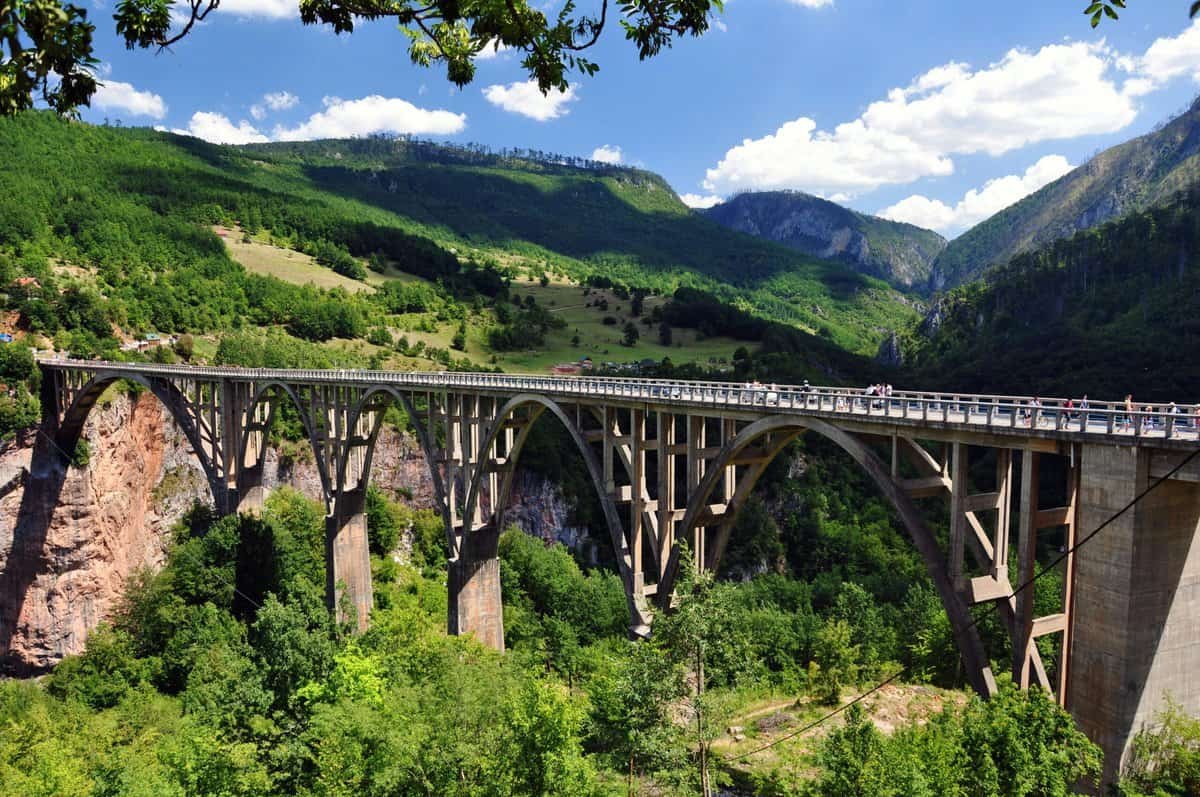
The launch point is Đurđevića Tara Bridge, and there are actually a few different zipline options at the site, ranging from a shorter, slower line to the longest one in the country at just over 1,000 metres, hitting speeds up to 100-120km/h depending on which operator runs it. You’re flying somewhere between 150 and 170 metres above the river, and the whole ride lasts under a minute.
🪂 Book it: Want to fly across the canyon instead of just looking at it? Book the Tara Bridge zipline here!
Part of the standard rafting route runs right along the border with Bosnia and Herzegovina, and most operators build in a stop on the Bosnian side for lunch. If you like the idea of crossing a border mid-adventure and just continuing on rather than turning back, it’s a short trip from here to Mostar and Sarajevo, both worth building into a longer Balkans route if you’ve got the time.
Savin Kuk Cable Car Ride
For those who want mountain views without committing to a long hike, the Savin Kuk cable car is the easiest way up. The ride takes you nearly 2,000m above sea level, offering a sweeping view over Black Lake, Žabljak, and the surrounding peaks. In summer, it’s a great way to get straight to the views without breaking a sweat, while in winter, it’s the heart of Durmitor’s ski scene.
Visit St. Michael the Archangel Orthodox Monastery
Built centuries ago, this small Orthodox monastery sits hidden among pine forests, its frescoes faded but still holding onto their stories.
Even if you’re not religious, there’s something calming about standing in the courtyard, surrounded by the silence of the mountains. It’s not the kind of place that’s on every tourist itinerary, but that’s part of the charm, you won’t be elbowing past groups of visitors here.
Glacial Lakes (“Mountain Eyes”)
Durmitor has 18 glacial lakes total. Black Lake is the one you’ll see without effort. Beyond that, Zminje Jezero (Snake Lake) is quieter and forest-hidden, and Vražje Jezero (Devil’s Lake) has the kind of turquoise water that looks fake in photos. We didn’t get to either.
Wildlife Spotting
The park is home to brown bears, wolves, and golden eagles, though actually seeing them takes genuine luck. Early mornings and sunsets are your best odds. We saw birds and not much else, which is normal. Most visitors don’t see the bigger stuff.
Cycling in Durmitor
Durmitor is not for casual cyclists, but for those who love a challenge, the roads and trails here are some of the best in Montenegro. The Durmitor Ring is a bucket-list ride for road cyclists. For mountain bikers, the park offers gravel trails and forested paths that cut through meadows and along rocky ridges. Some trails aren’t well-marked, so it’s worth asking locals or checking GPS routes before setting out. If you’re planning to cycle here, come prepared – long stretches of road have no services, no shade, and no quick exits.
Winter Sports in Žabljak
Žabljak turns into Montenegro’s ski town once the snow sets in, and it’s nothing like the Alps, which honestly seems to be the whole draw. Fewer crowds, cheaper lift tickets, none of the polish. Savin Kuk is the ski area to know, skiing, snowboarding, and cross-country trails, all set against Durmitor’s peaks buried in snow.
If skiing isn’t your thing, there’s snowshoeing across a frozen Black Lake, or sledding down the forested trails nearby. No lift ticket required for either. And after a day out in that kind of cold, Žabljak’s cafés are apparently the exact right amount of warm, hot rakija, thick stews, the whole deal.
Exploring Žabljak
At 1,450 meters above sea level, Žabljak is the highest town in the Balkans, and while small, it’s the perfect base for exploring Durmitor. Life here moves at a slower pace, with small bakeries, traditional restaurants, and a handful of wooden cabins offering a warm place to escape the mountain chill.
The food is exactly what you need after a day of hiking – thick stews, homemade bread, and hearty Balkan comfort food. Try kačamak, a rich dish made of cornmeal, cheese, and potatoes, or cicvara, a buttery polenta-like specialty that’s dangerously addictive. If you’re staying a few days, Žabljak’s market is a great place to stock up on local cheese and honey, straight from mountain farms.
Where To Stay Near Durmitor National Park
Casa di Pino EcoLodge Hotel | The boutique pick. A cozy alpine-style lodge just outside the entrance to Durmitor National Park with beautifully designed wooden interiors, exceptional breakfasts, and some of the highest guest ratings in the region.
Hotel SOA | The best full-service hotel near Black Lake. Modern rooms, spa facilities, and mountain views, all within walking distance of the park entrance.
NORTH STORY – Luxury Chalet – Apartments & Rooms | A stylish collection of modern chalets and apartments combining Scandinavian-inspired design with mountain scenery.
Vukov Konak – Wolf’s Lodge | If you’d rather stay in a cabin than a hotel, this is one of the best options. Rustic wooden lodges with mountain views, a peaceful forest setting, and exceptional hospitality.
How Many Days Do You Need in Durmitor National Park
Honestly, three days if you can manage it. Fewer than two days and you’re seeing the highlights reel. More than three, and you’re probably better off pairing it with proper downtime than more sightseeing, there’s only so much park to cover.
Here’s how it breaks down:
| Durmitor National Park Itinerary | What you get | Best for |
| 1 day | Black Lake, part of the Ring drive if you’re efficient about it | A stop on a bigger Montenegro road trip, not a dedicated visit |
| 2 days | The full Ring drive properly, Black Lake, time to actually sit by the lake after dark. Half day Tara Canyon. | What we did. Enough to feel like you experienced the park, not just drove through it |
| 3+ days | Everything above, plus a full day for Tara Canyon (rafting or the zipline) and a full day for a real hike | The version I’d actually recommend if your schedule allows it |
Best Time to Visit Durmitor National Park
We went in July. The coast was baking that week, Durmitor wasn’t. That contrast alone is reason enough to build it into a Montenegro trip rather than skip it for more beach time. If you’re mapping out where this fits into a longer route, my Montenegro itinerary has the full breakdown.
Summer (June-September): Peak season. Roads and high passes are reliably open, trails are clear. July/August get the most visitors, but nothing close to coastal crowds.
Autumn (September-November): Quieter, cooler, the forests turn. Better for solitude, worse for guaranteed access to every trail.
Winter (December-March): Ski season in Žabljak (covered above). Most summer activities, the Ring drive, the hikes, are shut once the passes close.
Spring (April-May): Waterfalls at their best from snowmelt, but expect some closures and mud until late May.
🛂 Montenegro is visa-free for anyone already holding a valid Schengen or US visa. I’ve also mapped out visa access for Pakistani passport holders across every other country – e-visas, visa-on-arrival, visa-free entries, and more. Check the visa tool
How to Get to Durmitor National Park
By car
The roads leading to Durmitor National Park are generally well-maintained, though some sections are steep and narrow, especially as you approach Žabljak. A good GPS or offline map is essential, as cell service can be unreliable in the mountains.
One thing worth knowing if you go this route: double-check your pickup location before you book. Some agencies in Montenegro operate outside the actual city center, which isn’t obvious until you’re standing at the wrong address with a flight to catch. If you want the fuller rundown on renting a car in this country specifically, here’s everything I ran into doing it myself.
From Podgorica: ~3 hours via Nikšić, the most straightforward route.
From Kotor or Budva: ~3.5 hours, a scenic but more winding drive through the mountains.
From Dubrovnik (Croatia): ~4.5 hours, crossing the border into Montenegro and continuing via Nikšić.
🚗 When comparing rental prices, I usually check Discover Cars first since it aggregates different companies and sometimes ends up cheaper than booking directly.
By Bus
If you’re relying on public transport, your best bet is to take a bus to Žabljak, the nearest town to the park. There are direct buses from Podgorica and Nikšić, but if you’re coming from Kotor, Budva, or Dubrovnik, you’ll likely need to transfer.
- Buses from Podgorica to Žabljak run several times a day and take around 3 hours.
- From Nikšić, the journey is about 2 hours.
- From Kotor/Budva, you’ll need to first get to Nikšić or Podgorica before continuing to Žabljak.
Montenegro’s bus schedules can be unreliable, especially in the off-season, so always check the latest timetables on GetByBus or at the local station. The Žabljak bus station is about a 10-minute walk from most accommodations, making it fairly convenient if you’re staying in town.
Getting Around Durmitor Without a Car
I would NOT skip the car. Everything in this guide that made the trip worth it, the Ring drive, the viewpoints, actually getting to Black Lake at a reasonable hour, assumes you can drive yourself around on your own schedule. But if driving isn’t happening for you, here’s what works, depending on where you’re starting from.
If you’re already in Žabljak
Žabljak sits about a mile from the main park entrance, so if you’re only after Black Lake and the hikes closest to town, walking genuinely covers it. You don’t need wheels for that part.
Once you want more than that, Tara Canyon, Savin Kuk, the further lakes, you’ll need some kind of transport, since none of it is walkable from town. Your options:
- Bike rentals, available in Žabljak itself. Fine for reaching Black Lake, but expect steep climbs if you push further into the park.
- Taxis, which can get you to trailheads or viewpoints for a reasonable price, useful if you just want dropped off somewhere specific rather than touring the whole park.
- Seasonal shuttle buses, which run in summer out to Tara Canyon and Savin Kuk. Seats sell out, so book ahead rather than assuming you’ll grab one on the day.
If you’re coming from the coast without a car
If you’re starting from Kotor, Budva, or elsewhere on the coast and don’t have a car at all, guided day tours are your best option, they handle the transport both ways so you’re not trying to piece together buses and taxis across a route that doesn’t really have public transport built for it.
🚍 Sightseeing option: This full-day Durmitor Ring tour runs from Herceg Novi, 13 hours door to door, from $90, and swings through Perast, Kotor Nikšić, Tara River, Žabljak and Ostrog Monastery on the way back.
🥾 Hiking option: If you actually want to get out of the bus and onto a trail, this one-day Montenegro hiking tour leaves Kotor, then hike up to the Škrčki Pogled and Prutaš/Crvena Greda viewpoints before heading back. Long day, but it gets you hiking rather than just looking out a bus window.
⛺️ I’ve put together my full backpacking gear list here if you want to see everything I carry. You can also browse it in my Amazon storefront.
Before You Go
We came for a beach holiday and left wishing we’d given Durmitor more time. That’s really the whole review. It was quiet in a way the coast never was, and a few days in, we realised we could’ve easily spent a week and still not run out of things to do.
Honestly, that’s how I felt about all of Montenegro. It’s a small country that somehow doesn’t feel small once you’re in it.
There’s unfinished business here for me, the rafting, the proper hike up Bobotov Kuk, both things I’d build a return trip around if I went back. If you’ve got more time than we did, do them for me.
If you’re still figuring out where Durmitor fits into a bigger Montenegro trip, I’ve laid out a full 10-day route here, Durmitor included.
