
Yellowstone is one of those parks that looks manageable on a map and then completely humbles you on day one.
I did this trip in June 2026, drove up from Grand Teton with my in-laws – ages ranging from 3 to 65 – and spent three days working through the first national park in the US and one that spans three states: Wyoming, Montana, and Idaho. The scale of it is genuinely hard to prepare for until you’re in it.
The thing that makes Yellowstone click is understanding the road system before you go. The Grand Loop Road is a 142-mile figure-eight, and this itinerary splits Yellow Stone National Park into efficient geographical chunks, one day per loop, plus a third day on the connector route in between. You move in one direction, you don’t double back, and you actually see the park instead of spending half of it in the car.
I saw a grizzly and three wolves on the same morning. Got hailed on in June. Watched a bison herd bring traffic to a full stop for twenty minutes. It truly is an incredible place.
How to Use This Itinerary
Yellowstone’s Grand Loop Road is a 142-mile figure-eight that connects all five park entrances and every major attraction. It’s divided into two loops:
- The Lower Loop in the south, which covers the geothermal features most people picture when they think of Yellowstone
- The Upper Loop in the north, which is higher elevation, more scenic driving, and significantly better for wildlife.
- A third section connects them through the middle of the park.
We drove in from Grand Teton via the South Entrance, but the order you tackle this is completely flexible. Coming in from the west? Start at Old Faithful. Flying into Bozeman? Do the Upper Loop first and work down. Clockwise or counter-clockwise, it doesn’t matter — what matters is keeping each section to its own day so you’re not crisscrossing the park.
One thing worth knowing before you go: parking is a nightmare between 9am and 4pm.If crowds affect your experience the way they affect mine, the sweet spot is early morning or late afternoon onwards. Sunset in June is close to 9pm, which means you have a long evening window that most day visitors miss entirely. Some of my favourite moments on this trip happened after 5pm.
Here’s a rough overview of how the three days break down:
| Driving Base | Key Stops | |
|---|---|---|
| Day 1 | Lake area, inside the park | West Thumb → Mud Volcano → Hayden Valley → Grand Prismatic Spring → Old Faithful |
| Day 2 | Lake area OR Emigrant/Gardiner, MT | Grand Canyon of the Yellowstone → Mt. Washburn → Norris Geyser Basin → Artist Paintpots |
| Day 3 | Emigrant/Gardiner, MT | Lamar Valley → Blacktail Plateau Drive → Tower Fall → Mammoth Hot Springs |
Getting to Yellowstone
Flying In
The three airports most people use are Jackson Hole (JAC), Salt Lake City (SLC), and Bozeman (BZN).
Jackson is the most convenient – you land, you’re already in Wyoming, and Grand Teton is basically on your doorstep. If money isn’t a factor, fly into Jackson. If you have the flexibility to fly out of somewhere different, I’d actually fly into Jackson and out of Bozeman, which lets you do the parks south to north without backtracking. Just check that your car rental allows a one-way drop-off before you book.
We flew into SLC because it was the only direct flight we could find from Toronto that didn’t cost a small fortune. The drive up is around four to four and a half hours and honestly, it’s pretty scenic once you’re past the Salt Lake sprawl. We split it over two days to make sure we had a full first day in Grand Teton. Not a bad call.
Renting a Car
Non-negotiable. There is no meaningful public transit inside the park, and the distances between attractions make ride-sharing completely impractical.
If you’d rather not drive, guided tours are a solid option – I’ve linked some good ones below. But if you want the flexibility to stop whenever a bison decides to cross the road or someone points a scope at something in the distance, you need your own car.
🚗 When comparing rental prices, I usually check Discover Cars first since it aggregates different companies and sometimes ends up cheaper than booking directly. We ended up with Avis, but another company was cheaper the week before.
Day 1 – The Lower Loop (Geysers, Hot Springs + Wildlife)
The Lower Loop is the southern half of the figure-eight and the most visited section of the park. It has active geysers, the largest hot spring in the US, and the best wildlife corridors in Yellowstone. We ran it counter-clockwise, starting from the south entrance, and I’d recommend you do the same, by the time you reach Old Faithful in the late afternoon, most of the day crowds have already left.
Morning: West Thumb + Hayden Valley
First stop is West Thumb Geyser Basin, right on the edge of Yellowstone Lake. Active geothermal features sitting directly on the shoreline, with the lake stretching out behind them. Walk the boardwalk before the crowds build.
From there, drive east along the lake towards Hayden Valley.
If you’re arriving the evening before Day 1, Mud Volcano is worth a stop on the way in. We pulled in at dusk with basically no one around, a bison herd grazing on the hill above us and two kids simultaneously fascinated and deeply unsure about the smell. And the smell is something – sulphuric, sharp, and hits you before you’ve even opened the car door. The mud here is actively boiling and bubbling up from below, and the Black Dragon’s Caldron is a churning, coal-black pool that looks super fascinating. Go at dusk if you can.
Mud Volcano sits just south of Hayden Valley, so you’ll pass it either way.
Hayden Valley itself is a wide, open stretch of land bisected by the Yellowstone River and one of the best wildlife viewing spots in the park. Drive slowly. Pull over whenever you see a cluster of cars stopped ahead, that’s almost always a wildlife jam and almost always worth investigating.
We spotted a grizzly running through the valley on the way in. Then, through a stranger’s scope at a pull-off, we watched another grizzly feeding on a carcass in the distance. The wildlife watching culture here is genuinely lovely – people set up with serious equipment and will let you look through their scope if you ask. They usually know exactly what they’re looking at and are happy to tell you.
Afternoon: Grand Prismatic Spring + Old Faithful
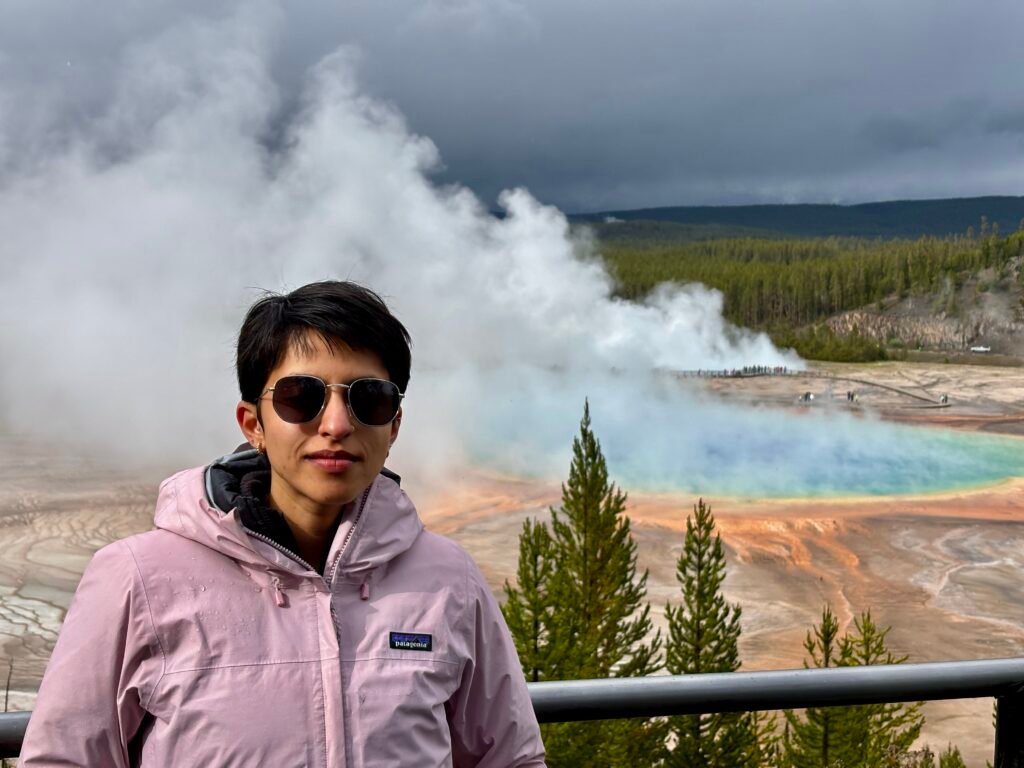
Midway Geyser Basin is home to Grand Prismatic Spring, the largest hot spring in the US. The colours — deep blue at the centre bleeding out into rings of green, yellow, and orange — come from heat-loving bacteria at different temperatures around the edges. Up close on the boardwalk it’s impressive. From the overlook above, it’s something else entirely.
Do the overlook. The Grand Prismatic Overlook Trail starts at the Fairy Falls Trailhead, covers 1.2 miles (1.9 km) round trip, climbs about 105 feet (32 metres), and takes roughly an hour. It’s where that famous aerial image actually comes from. We went up in the rain and it was still one of the highlights of the trip. Go in the morning and expect overflow parking and a queue for the trail. Late afternoon, we had it almost to ourselves.
Then Old Faithful.
I’ll be honest: it didn’t fully live up to the hype for me personally. It’s impressive, but it’s also extremely managed, you sit in a semicircle of benches with hundreds of other people and wait. What I didn’t expect to like as much was the surrounding Upper Geyser Basin boardwalk, which winds past a dozen other active geysers and hot springs and feels considerably less crowded. Morning Glory Pool is further along the trail and worth the extra walk.
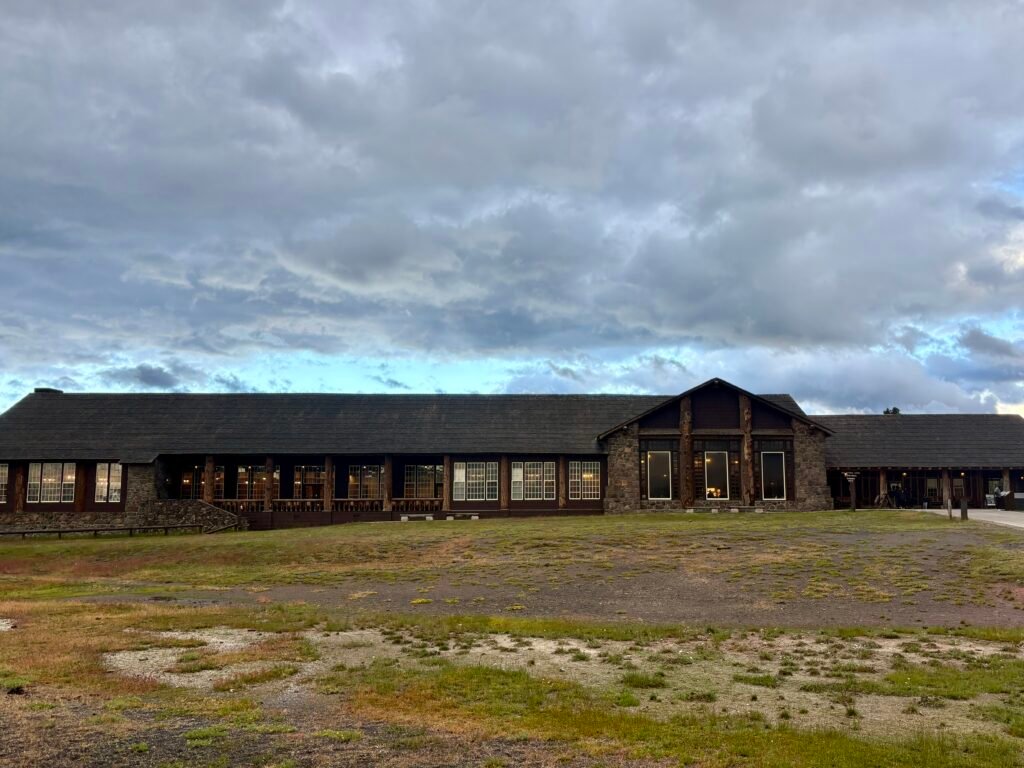
The visitor centre posts predicted eruption times – Old Faithful goes roughly every 90 minutes, so if you arrive and just missed one, you have time. We went into the Old Faithful Inn cafeteria, had a decent meal, and came back out for the next eruption with a front-row spot. The inn itself is stunning, a huge log structure built in 1904. I wished I could afford to stay there.
You can check geyser eruption forecasts before and during your visit.
🌋 A guided tour of the Lower Loop means a local expert handling the navigation, the wildlife spotting, and the geyser timing. Join a guided Lower Loop tour
Where to Stay – Night 1
Staying inside the park for night one makes the logistics significantly easier. You’re already deep in the southern section and an early morning start the next day doesn’t require a long drive in.
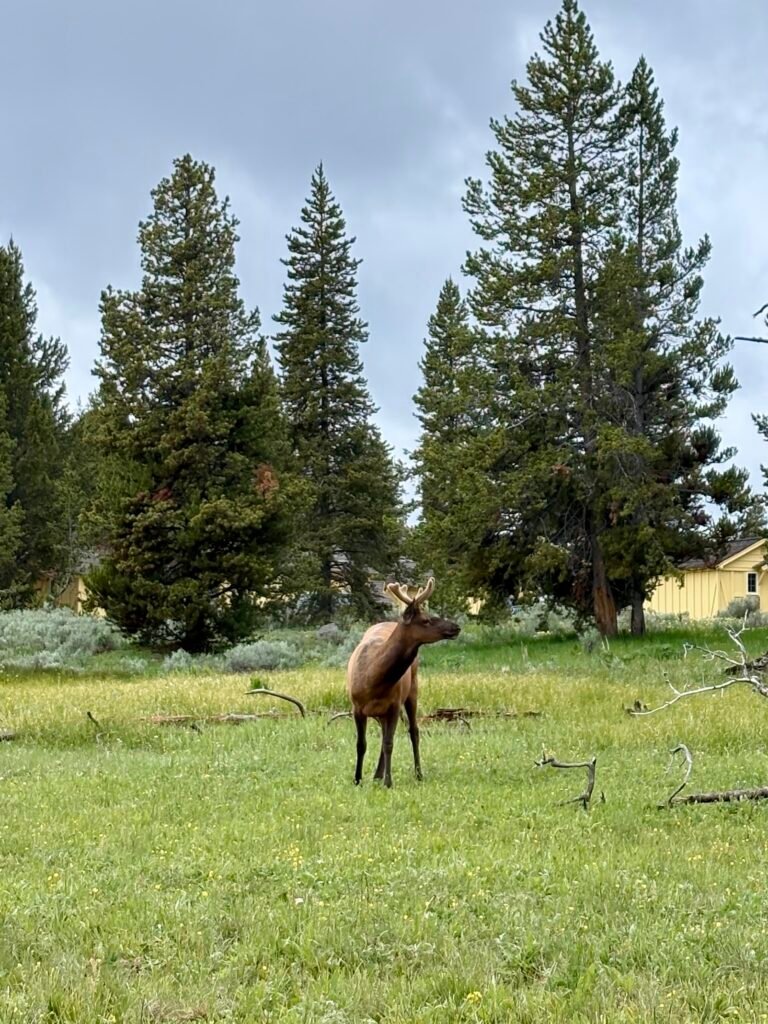
We stayed at Lake Lodge Cabins and I genuinely loved it. Each cabin has two queen beds, there’s a cafeteria with fixed hours and reasonable prices, and you’re right on Yellowstone Lake. We had elk outside the cabin. Bison nearby. It’s the kind of place that feels very far from everything, because it is.
The other inside-park option for this section is Old Faithful Inn. Both book out six to twelve months in advance for summer – but cancellations do happen around the one-month mark, so it’s worth checking back.
If you’d rather stay outside the park, both the West and South Entrances have solid options at a lower price point.
West Entrance
1872 Inn – Adults Exclusive | Boutique, adults-only, just over a mile from the West Entrance. Fireplaces, mountain-modern rooms, complimentary breakfast. Perfect for a quieter stay.
Under Canvas West Yellowstone | Luxury safari-style tents with wood-burning stoves and private bathrooms, ten minutes from the entrance. Glamping done properly.
South Entrance
Headwaters Lodge & Cabins at Flagg Ranch | Two miles from the South Entrance, on-site restaurant, works well as a base for both Yellowstone and Grand Teton.
Teton Cabins | If you’re after a classic Wyoming cabin experience, these modern log cabins near Moran are hard to beat. Full kitchens and easy access to both parks.
Day 2 – The Middle Section (Grand Canyon of the Yellowstone + Norris)
The connector route between the two loops is the section most people underplan. It doesn’t have the headline draw of Old Faithful or the wildlife density of Lamar Valley, but it has the most dramatic scenery in the park and the highest concentration of geothermal activity anywhere in Yellowstone. We got rained on, hailed on, and still thought it was worth every minute.
Morning: Grand Canyon of the Yellowstone
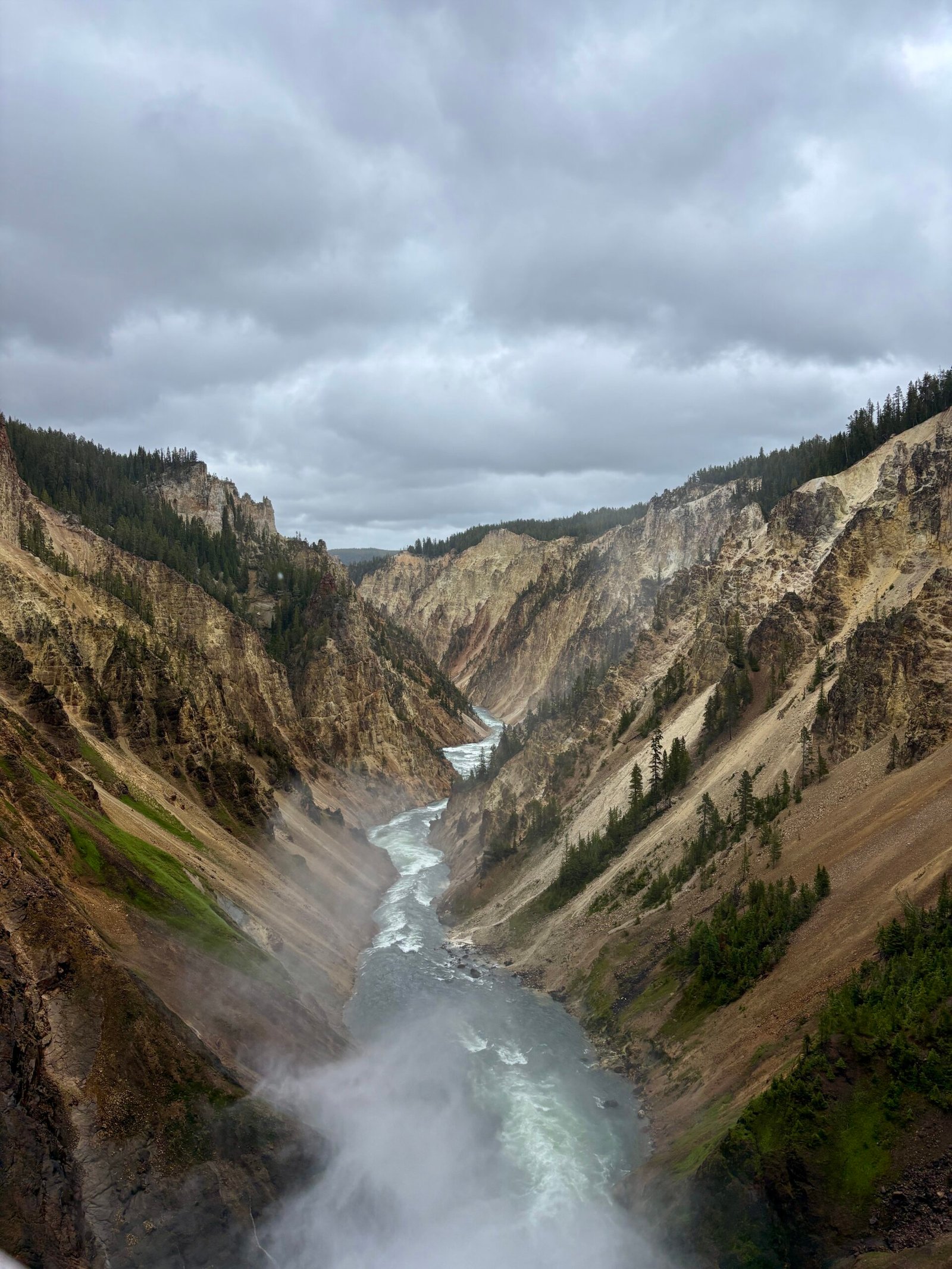
First stop is Artist Point, the main viewpoint over the Grand Canyon of the Yellowstone. The canyon runs for twenty miles and the Lower Falls drop 308 feet (94 metres) into it, nearly twice the height of Niagara. The colour of the canyon walls is what catches you off guard. They’re yellow and rust and ochre, streaked from centuries of hydrothermal activity, and the river threading through the bottom is this vivid turquoise green.
We got unlucky with the weather. It was raining, and at one point there was actual hail. I’m from Toronto. I am completely snowed out for the year. The last thing I wanted was to get caught in a hailstorm on a summer trip. It was still genuinely beautiful. I can only imagine what it looks like on a clear day.
Artist Point is the must-do viewpoint. Get there early, parking fills up fast and there’s no good alternative once it does. The Upper Falls viewpoint is a short drive away and worth adding on; the scale is different but it’s a good contrast.
Midday: Mt. Washburn
If you’re up for one proper hike in Yellowstone, this is the one I’d pick. Mt. Washburn sits in the middle of the park and the summit gives you a panoramic view of the entire Yellowstone caldera – which, for context, is one of the largest supervolcanoes on earth.
There are two trailheads: Dunraven Pass and Chittenden Road. Both are roughly 3 miles (4.8 km) each way with about 1,400 feet (427 metres) of elevation gain. Plan for three to four hours return. It’s a steady climb but not technical so well within reach for anyone with reasonable fitness.
Bighorn sheep are regularly spotted near the summit fire lookout. I didn’t see any, which I was genuinely bummed about. But the views from the top make up for it.
Afternoon: Norris Geyser Basin + Artist Paintpots
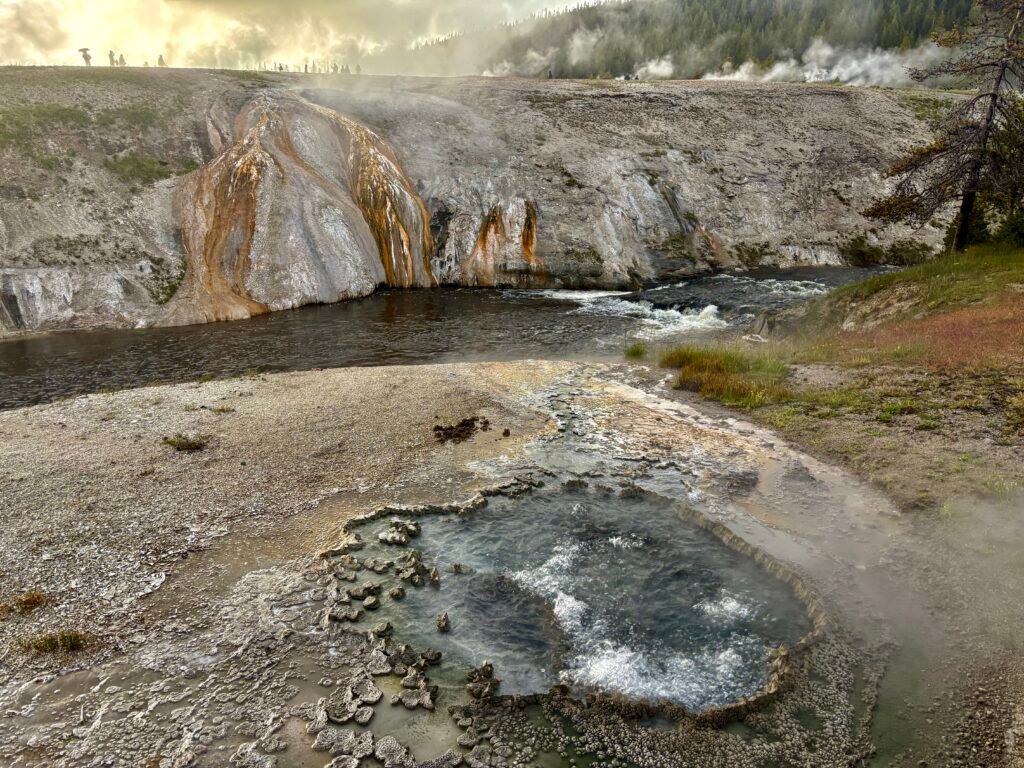
Norris Geyser Basin is the hottest and most geologically active thermal area in the park. It sits on the intersection of three fault lines, which means the landscape here shifts constantly – features that existed last year sometimes don’t exist this year. There’s a small museum at the entrance that explains the difference between a hot spring, a fumarole, and a geyser, and it’s actually worth ten minutes of your time before you hit the boardwalks.
The boardwalks split into two loops: the Porcelain Basin loop and the Back Basin loop. Porcelain is open and stark, all white silica and steaming vents with very little vegetation. Back Basin is more forested and takes you past Steamboat Geyser, the world’s tallest active geyser. Combined, plan for about ninety minutes to two hours.
I found Norris genuinely impressive, even after two days of geothermal features. It has a different energy to Old Faithful and Midway – rawer, less managed feeling.
Artist Paintpots is a shorter stop, about a mile (1.6 km) round trip, and considerably less crowded than anywhere else you’ll have been. Colourful mud pots and geothermal features in a quieter setting. A good way to end the afternoon before heading back.
Where to Stay – Night 2
For night two you have two options. You can stay in the same place as night one and drive up to the middle section in the morning, or you can move to your northern base tonight so you’re already positioned for Day 3. We did two nights at Lake Lodge and then moved to Emigrant, but honestly either split works. It just depends on how much driving you want to front-load.
The northern accommodation options are coming up in the Day 3 section.
Day 3 – The Upper Loop (Lamar Valley, Tower Fall + Mammoth Hot Springs)
The drive north into the Upper Loop is where Yellowstone stops feeling like a geothermal wonderland and starts feeling like the American West you’ve seen in films. The landscape opens up completely. Wide valleys, open skies, rolling hills in every shade of green and gold. If you’ve been watching the Yellowstone TV show and wondering where that landscape actually is, this is it. Montana is genuinely beautiful and the northern section of the park bleeds right into it.
Morning: Lamar Valley
We debated this the night before. Neither of us are sunrise people. We went back and forth, talked ourselves into it, talked ourselves back out of it, and eventually just set the alarm and committed.
The drive in is a bit scary. It’s dark, it’s early, and Yellowstone at dawn has a completely different energy. We drove slowly, windows down, genuinely a little nervous about what might step out in front of the car. Bison don’t care about your headlights.
Lamar Valley is a wide, sweeping valley in the northeast corner of the park, often called the Serengeti of North America for its density of large predators. It’s the best place – arguably in the world – to see wolves in the wild.
Wolves were reintroduced to Yellowstone in 1995 after a seventy-year absence, and their return changed the entire ecosystem – elk populations shifted, overgrazed riverbanks recovered, beavers and songbirds came back. Seeing them in real life is truly fascinating.
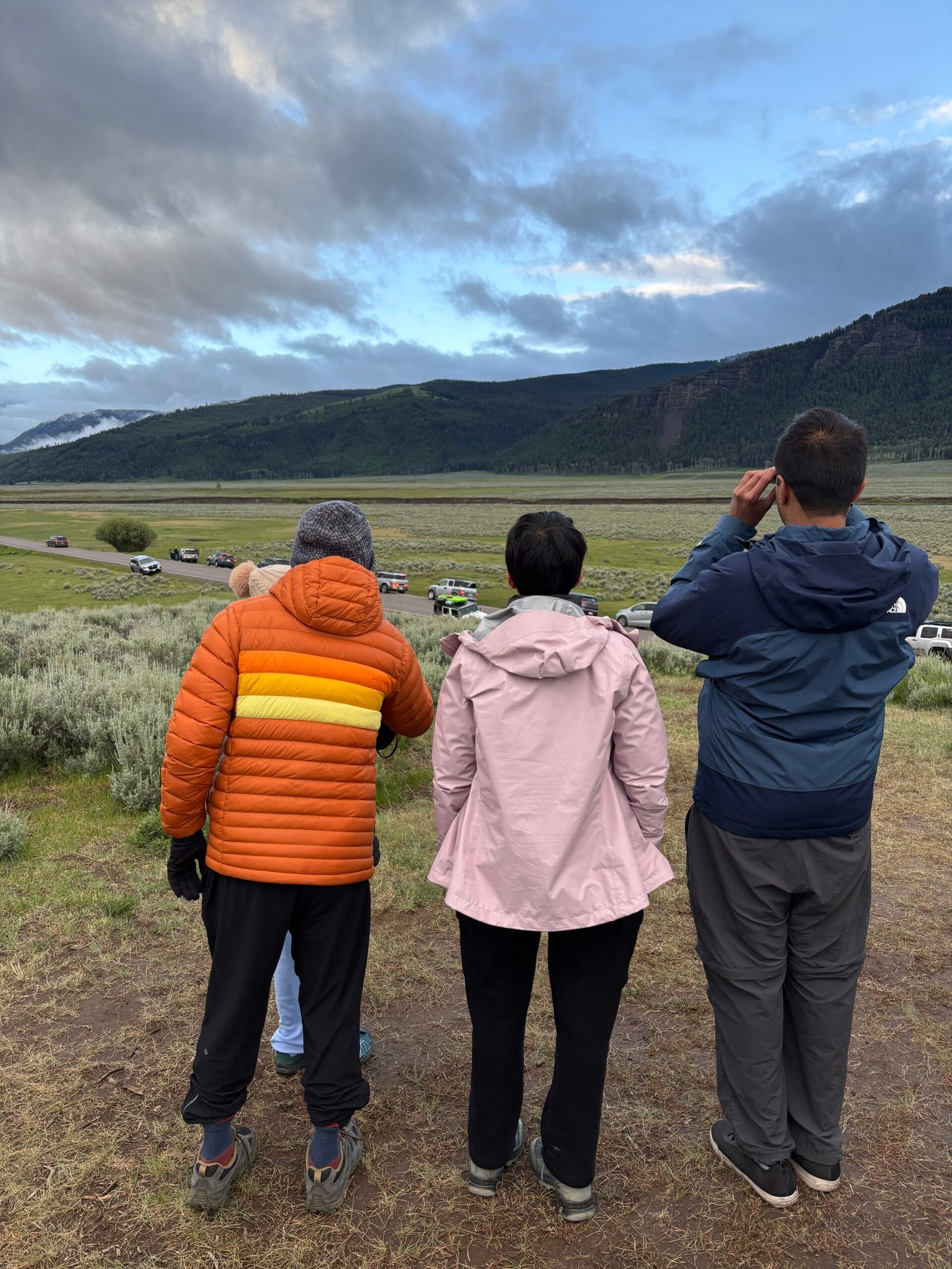
We reached the valley just before sunrise and did what I’d recommend you do: drove slowly along the valley road looking for people pulled over with spotting scopes. A group of three wolf watchers had been set up since before first light, tracking the Junction Butte Pack – one of the most frequently observed packs in the park, based near the confluence of the Lamar River and Soda Butte Creek. They let us look through their scope without us even having to ask.
The pack was long led by 907F, one of the oldest recorded wolves in Yellowstone’s history. Researchers called her the Queen of Wolves. She led the pack for years despite losing the use of one eye.
Through the scope, we watched three wolves and a grizzly in a standoff over an elk carcass. On the drive back later that day, another pull-off, another cluster of scopes, and this time wolf pups.
I hate waking up early. I would do it again without hesitating.
🔭 Rather have an expert guide you through Lamar Valley at dawn? Join a guided wildlife tour of the Upper Loop or book a private upper loop tour if you’re travelling as a group.
Bring binoculars – even a cheap pair from amazon makes a real difference out here!
Afternoon: Blacktail Plateau Drive + Tower Fall
After Lamar Valley, you’re heading west along the northern section of the loop. Two stops worth making on the way.
Blacktail Plateau Drive is a one-way dirt road that runs parallel to the main highway for about six miles (9.6 km). It’s quieter than the main road, slower, and significantly better for wildlife spotting. It adds maybe twenty minutes to your drive but it’s worth it if the morning’s wildlife watching has you in that headspace.
Tower Fall is a 132-foot (40-metre) waterfall tucked into a narrow canyon just off the main road. The viewpoint is a short walk from the car park. It’s not a long stop – thirty minutes is plenty – but the canyon walls around it are dramatic and it’s a good contrast to the open valley you’ve spent the morning in.
Evening: Mammoth Hot Springs
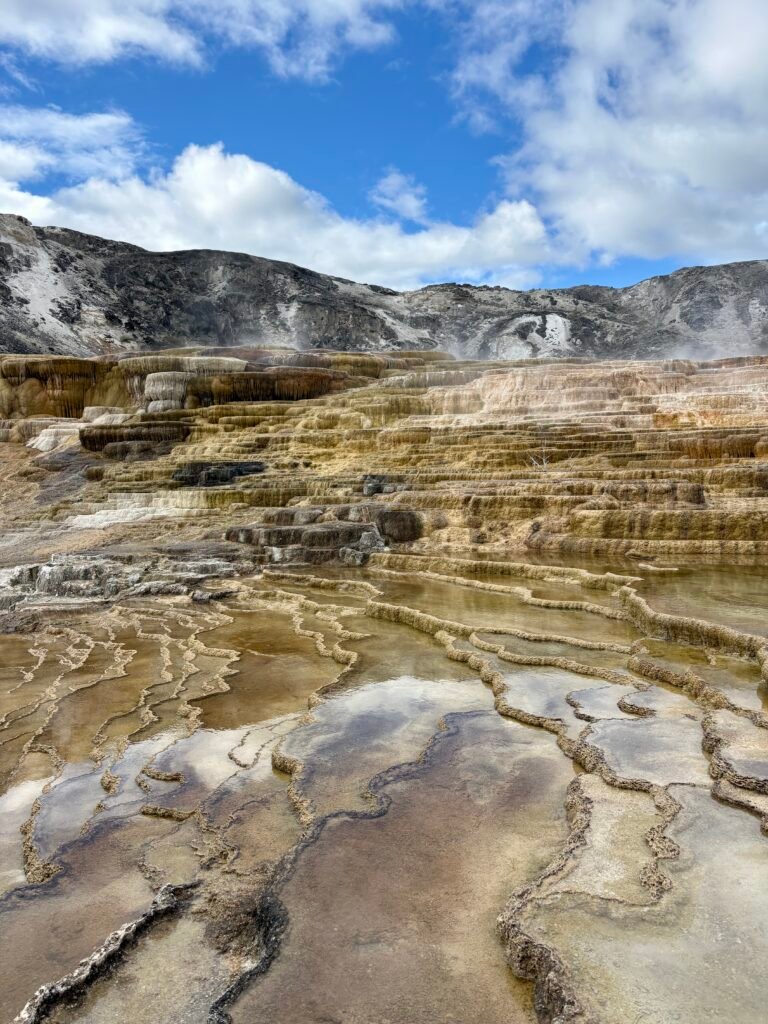
The hot springs here are completely different from anything else in the park. Instead of pools and geysers, you get terraced travertine formations cascading down the hillside – layer after layer of mineral deposits built up over thousands of years. The closest visual comparison is a frozen waterfall, except the colours are wrong for ice: white and cream and pale orange, steaming gently at the edges. It looks like something that should be in a geology textbook, not sitting in front of you.
There are upper and lower terraces, both worth walking. The landscape shifts constantly as mineral deposits build in some areas and dry up in others — features that existed on a previous visit may not exist on your next one. It keeps the place feeling alive in a way that’s hard to explain.
Mammoth is also a functioning townsite inside the park, which means elk wandering through the car park is just a normal Tuesday. Give them space – they’re unbothered and you should be too.
If you can afford to stay here, it’s probably the best base in the park for the Upper Loop. More on that in the Where to Stay section below.
🚣 Fancy a different kind of Yellowstone experience? Book a rafting trip on the Yellowstone River – a two-hour float through the Paradise Valley just outside Gardiner.
Where to Stay – Night 3
For the northern section, your three options are Mammoth inside the park, or Gardiner and Emigrant outside.
Mammoth Hotel is the most convenient base — you’re already inside the park and early Lamar Valley runs don’t require a long drive in. It’s also the priciest and books out fastest.
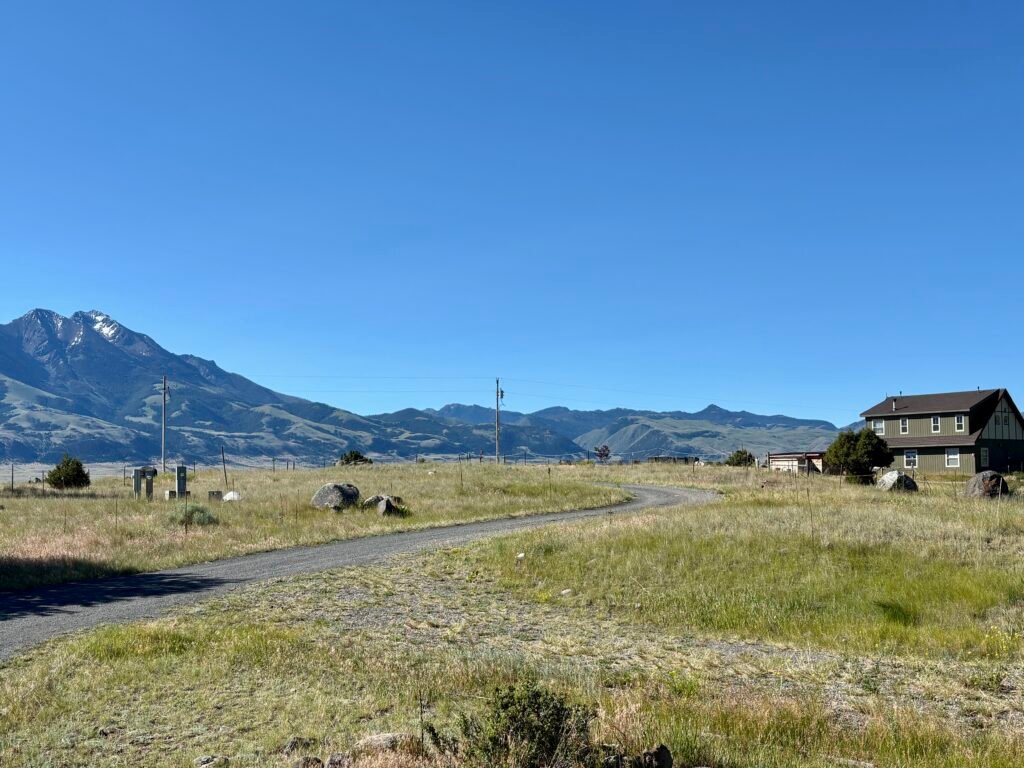
We stayed in Emigrant, about 35 minutes from the north entrance. If I were doing it again, I’d base in Gardiner – it’s closer, has more options, and saves you unnecessary driving time on already long days. That said, Emigrant has its own thing going on. Open fields, green mountains, proper cowboy town energy. We ate at the Old Saloon and the Emigrant Outpost brewery. Both worth a stop if you end up there.
Dreamcatcher Tipi Hotel | Luxury furnished tipis ten minutes from the North Entrance, real beds, complimentary breakfast, nightly campfires. The unique pick.
Yellowstone Village Inn & Suites | Modern hotel a few minutes from the North Entrance, indoor pool, mountain views. The reliable pick.
Sage Lodge (Emigrant) | Upscale riverside lodge in Emigrant with a full-service spa, excellent dining, and sweeping views of Paradise Valley. The splurge pick.
Practical Info for Visiting Yellowstone
Entrance Fees
Yellowstone costs $35 per vehicle for US residents, valid for seven days. Non-US residents pay $100 per person – a price that increased under the Trump administration. We were four people heading to two parks, which would have cost us $800 in entrance fees alone.
The America the Beautiful Pass is $250 and covers everyone in your vehicle for all US national parks for a full year. If you’re visiting more than two parks, it pays for itself immediately. It’s available at the park entrance.
Getting Around
A car is non-negotiable. Driving each loop straight through without stops takes three to four hours – with wildlife jams, boardwalks, and pull-offs, plan for eight to twelve hours per day. Parking fills up fast at major stops between 9am and 4pm. Start early or go late.
Cell Signal + Navigation
Signal is patchy throughout the park and nonexistent in large sections. Download offline Google Maps before you leave your accommodation. Don’t rely on data.
Geyser Eruption Forecasts
Old Faithful and several other geysers have predicted eruption windows. Check go.nps.gov/geysertimes before each day so you can plan your timing around them.
Tours + Ranger Programs
Free ranger-led programmes run daily from most visitor centres — check the schedule posted at each one when you arrive. If you’d rather have a guide for the full day, guided tours are available for both loops. I’ve linked the ones I’d recommend throughout the day sections above.
Wildlife Safety
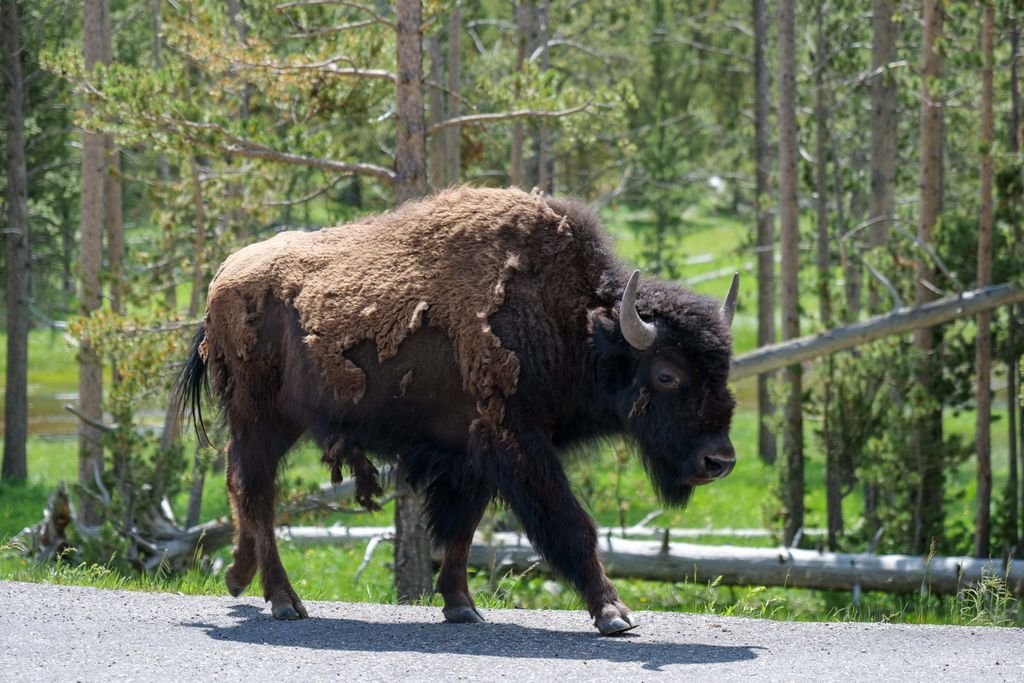
Stay at least 100 yards (91 metres) from wolves and bears, and 25 yards (23 metres) from bison and other wildlife. Bison are responsible for more injuries in the park than any other animal. Carry bear spray if you’re hiking anywhere off the boardwalks.
Best Time to Visit Yellowstone
Summer (June to August) is peak season – all roads open, maximum crowds. Book accommodation six to twelve months ahead and start your days early.
May and September are the sweet spots. Fewer crowds, lower prices, park fully accessible. We went in June and found the evenings surprisingly quiet.
Winter closes most roads to regular vehicles. The park shifts to snowmobile and snowcoach access only. That said, it’s the best season for wolf sightings – they’re significantly easier to spot against snow than in summer vegetation.
What to Pack for Yellowstone
Layers are non-negotiable – we got hailed on in June. Beyond that, the things that made the biggest difference were binoculars for Lamar Valley and bear spray for anything off the boardwalks.
I keep an updated packing list on my Amazon storefront with everything I actually travel with.
Make It a Week
Three days is enough to see the best of Yellowstone without feeling like you’ve rushed it. The Grand Loop framework does the heavy lifting – you’re never backtracking, never wasting driving time, and you leave having seen the geysers, the canyon, the wolves, and Mammoth.
Most people doing this trip are combining it with Grand Teton, which is two hours south via the same road you came in on. If you haven’t planned that leg yet, here’s how we spent two days in Grand Teton.
