
Planning a Killarney camping trip means figuring out routes, campsites, and access points all at once, usually without understanding how they affect each other.
I didn’t grow up doing this. When I moved to Canada, I didn’t even know what portaging meant. My first canoe trip in Algonquin was planned for me. Then we went to Killarney, and it felt quieter, more spaced out, and a bit less forgiving if you didn’t know what you were doing.
This year, I’m planning the trip myself, and the biggest shift is understanding how everything connects before you book anything.
If you’re new to canoe camping, the main decisions come down to your route, your access point, and how much you’re actually taking on for your first trip. Getting those right makes the rest of it a lot easier.
Map and Overview
Before you start picking routes or campsites, you need to look at a map. Not skim it, actually sit with it.
Killarney is made up of connected lakes, with portages linking them together. Where you enter the park determines which routes are even possible, and small differences on the map can mean very different travel days.
The park itself is relatively compact, but dense. You’re looking at over 50 lakes spread across quartzite ridges, granite shoreline, and forest. That’s what gives Killarney its look, clear blue water, exposed rock, and very defined routes through the landscape.
It’s also why it feels different from somewhere like Algonquin. Fewer campsites, more separation between them, and less room to adjust your plan once you’re out there.
There’s a reason this area has been painted and photographed as much as it has. The terrain is distinct, and once you see it on the map, it starts to make more sense why routes look the way they do.
The easiest way to understand the park is to use a proper map. I use Jeff’s Maps because it shows portage lengths, campsite locations, and estimated travel times in one place. You can start to see how a route actually works, not just where things are.
When you open the map, focus on three things:
- Access points (where you enter)
- Lake connections (how you move between them)
- Portages (distance and frequency)
As you go through this guide, keep the map open and follow along. That’s how you turn this from “a bunch of names” into an actual plan.
1: Decide What Kind of Canoe Trip You’re Doing
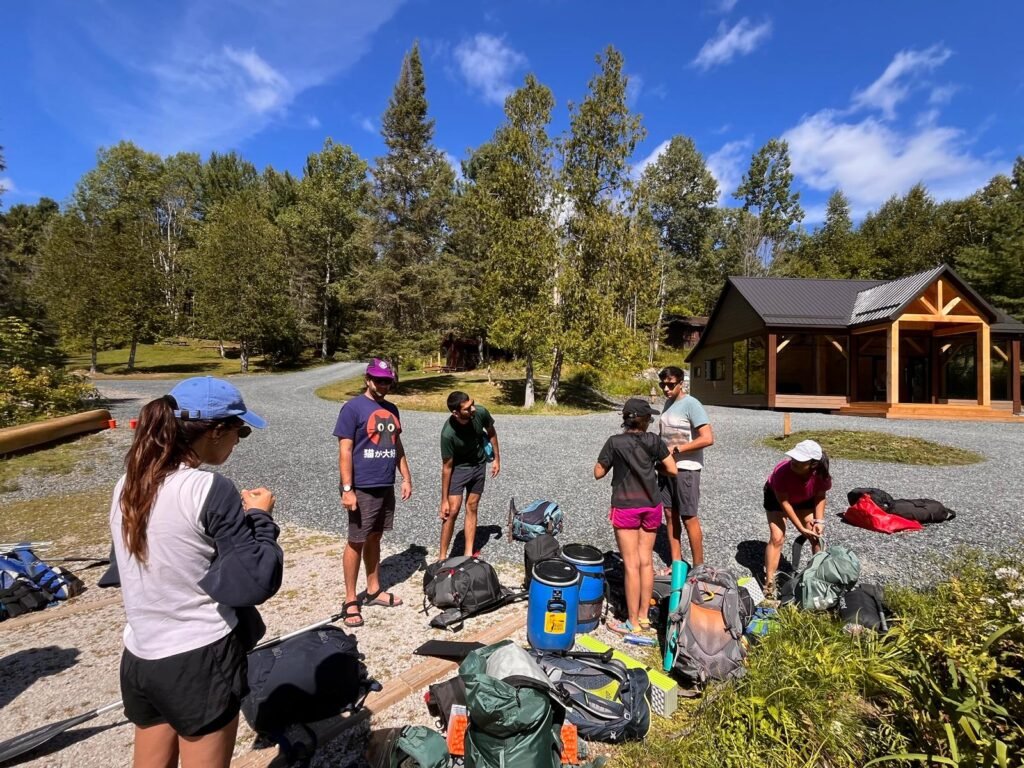
Start with this: basecamp or loop.
A loop means you’re moving every day, paddling and portaging from one lake to another, eventually circling back to where you started.
A basecamp (or there-and-back) means you paddle into one lake, set up camp, and stay there for your trip. You might do short day trips or hikes, but your gear stays in one place.
For a first trip, do a basecamp or there-and-back. Loops add a lot more work, more packing, tighter timelines, and less room for mistakes.
You’ll still get the full experience, paddling, setting up camp, being out there, without adding unnecessary pressure to keep moving every day.
- Choose a route with short travel time on day one
- Avoid stacking multiple portages right away
- Don’t plan to cover a lot of distance
There’s a common temptation to try and “make the most” of a trip by doing a loop. But for a first trip, doing less usually means you enjoy it more and actually want to come back.
2: Pick Your Dates
You can book sites up to 5 months in advance on the Ontario Parks website, and for summer weekends, you pretty much have to. It’s a small park with limited campsites, so availability disappears quickly.
For timing:
- July–August → easiest weather, busiest
- September (especially around Labour Day) → fewer people, cooler nights, shorter days
- Shoulder season (May, October) → colder water, more risk, less forgiving
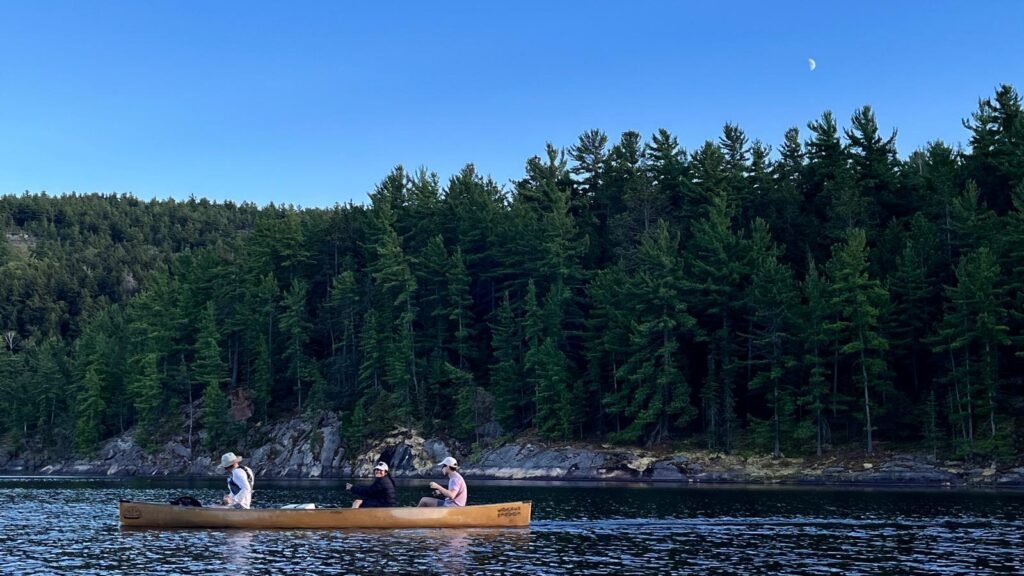
We went over Labour Day weekend and it was ideal, warm during the day, cool at night, and no bugs.
For your first trip, keep it short. 2-3 nights is enough.
That gives you:
- Day 1: paddle in
- Day 2: actually enjoy being there
- Day 3: paddle out
- Affiliate box or any extra infomration that might be helpful.
3: Choose Your Access Point
On the booking site, you’ll see multiple access points, but they’re not interchangeable. Each one puts you in a different part of the park and changes what routes are realistic.
Most people enter from the southern edge of the park along Highway 637. If you look at the map, moving roughly along that southern side, you’ll see:
Bell → Johnnie → Carlyle → George
These are the most practical entry points for a first trip.
Bell Lake
Bell is one of the best starting points for beginners.
It gives you access to routes that are manageable without committing to long or difficult portages right away. You can build a short, controlled trip and still feel like you’re properly in the backcountry.
A common setup:
- Bell → David Lake → Boundary Lake (basecamp)
🥾 If you want to add a hike, you can reach Silver Peak from the west end of David Lake (520 m portage). Treat it as a full-day outing, not something to combine with travel.
Johnnie Lake
Johnnie sits between Bell and Carlyle.
There’s less written about it, which makes it harder to plan from guides alone. It opens a different part of the park, but without the same clear beginner routes you’ll find from Bell or George.
If you’re choosing Johnnie, you need to rely on the map and build your own route rather than following a standard one.
Carlyle Lake
Carlyle sits between Johnnie and George and falls into the same category.
It’s a valid access point, but there’s less guidance available and fewer obvious beginner routes. If you’re comfortable reading the map, it works. If not, Bell or George are easier starting points.
George Lake
George is the most straightforward and most popular access point.
It connects directly to Killarey Lake and O.S.A Lake
Typical beginner route:
- George → Freeland → Killarney (→ OSA if extending)
The portages in this corridor are relatively manageable, which is why it gets booked quickly.
George Lake itself works fine for a quick overnight, especially if you’re arriving late, but it’s better treated as a starting point rather than somewhere to stay your whole trip. Once you move further in, Killarney Lake has better campsite spacing, particularly toward the middle and eastern sections. OSA is more limited, with only a handful of sites, and it can be difficult to secure even outside peak dates.
If you’re planning to go deeper, the route through Killarney Lake is generally more practical than taking the direct George to OSA portage, which is longer and more demanding.
🥾 If you want to add a hike, The Crack can be accessed from the south end of Killarney Lake (1,370 m portage). It’s a full-day commitment and more crowded than you’d expect.
Highway 6 Access (Widgawa Lodge)
Located off Highway 6 south of Espanola, Widgawa Lodge gives access to the northwest side of the park.
From here you can reach Nellie Lake and Leech Lake.
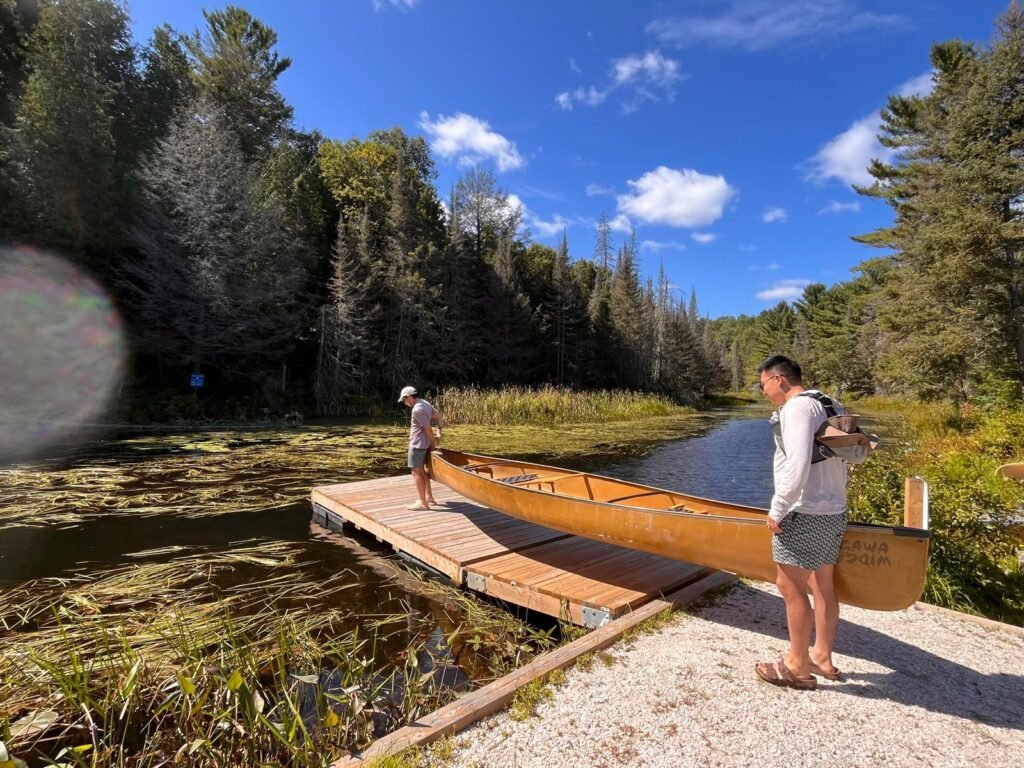
This area is significantly less crowded than the southern access points and gives you direct entry into quieter lakes. Canoe rentals are available on-site at Widgawa Lodge (book in advance), and parking is limited but straightforward.
This was my first trip to Killarney, and it’s a good option if you want something less busy and are comfortable doing a bit more planning yourself.
Walker Lake (North Access)
Walker Lake gives you access to the north side of Killarney and is another quieter alternative.
You reach it from Espanola via Panache Lake Road, turning near Mountain Cove Lodge and continuing to the launch. The road is mostly straightforward, with a narrower final section. Parking is right at the launch, and canoe rentals are available nearby.
This side of the park feels different. The terrain is more granite than quartzite, the lakes are less stark, and there’s generally more plant life. It’s also less crowded.
From here, you can access areas like Leech and Nellie, though some routes involve steep portages and are better approached as day trips rather than rushed travel days.
4: Choose Your Campsite (and Book It)
For Killarney camping, the reservation system is campsite-specific, not lake-based.
That means you’re booking an exact site for each night. If you book Site 135 for night one and Site 210 for night two, you’re moving camps, even if you’re on the same lake.
This is different from places like Algonquin, and it changes how you plan your trip.
How to Choose Your Campsite
At this point, you already have your access point and a rough idea of your route style (basecamp).
Now you’re looking for a site that:
- You can realistically reach on day one
- You can stay at for 2 nights (ideal for beginners)
For a first trip, keep it simple:
- George access → Killarney or OSA
- Bell access → David or Boundary
Step-by-Step: How to Book on Ontario Parks
- Go to the Ontario Parks reservation system
- Select Backcountry → Paddle (Canoe Routes)
- Choose Killarney Provincial Park
- Enter your dates (remember: bookings open 5 months in advance)
- Select your access point (this filters your options)
- Browse available campsites for each night
At this point, you’ll see what’s actually available, and this is where most plans change.
- Pick a site you can reach comfortably on day one
- Try to book the same site for both nights
- Complete your reservation
Booking Strategy (this matters more than anything)
- Check availability first, then build your route
- Don’t lock into a plan before seeing what’s open
- Be flexible with lakes and exact sites
- If nothing works, adjust your access point
Killarney is small and in high demand. If you wait too long or try to force a specific route, you’ll run out of options quickly.
5: Sanity Check Your Plan
At this point, you’ve picked your access point and booked your site. Before you move on, take a minute to check that your plan actually makes sense.
The biggest thing to look at is your day one travel. Can you realistically reach your campsite without rushing? Remember that everything takes longer than expected the first time, paddling, loading, portaging, and just figuring things out as you go.
Portages are usually where plans fall apart. A route with one short carry feels very different from one with multiple or longer ones, even if the distance looks similar on the map.
This is also where it helps to map everything out. Toss your route into Paddle Planner while you’re planning, it gives you a much clearer sense of distance, portage length, and estimated time. Just assume it will take you longer than what it says.
Finally, look at your overall plan. If you’re trying to paddle in, set up camp, and do a big hike all on the same day, it’s probably too much. Keep your first trip simple and give yourself time to adjust once you’re out there.Affiliate box or any extra infomration that might be helpful.
6: Food, Water, and Wildlife
Keep your food simple. Easy meals you can make quickly and clean up without hassle are always better than anything complicated.
Plan for three meals a day plus snacks, but don’t overpack. Weight adds up fast, especially if you have portages.
For water, assume everything needs to be treated. Bring a filter or another method and carry enough between stops so you’re not scrambling.
For wildlife, focus on food storage. Use a bear barrel or hang your food properly, don’t leave anything out, and keep your campsite clean. Bears are present in the park, but most issues come from smaller animals getting into food that isn’t stored properly.
7: What to Pack for Canoe Camping
You don’t need a perfect gear setup for your first trip, but you do need the basics dialed in.
Start with shelter and sleep. A reliable tent, a sleeping bag suited for the temperature, and a proper sleeping pad. If you’re uncomfortable at night, everything feels harder the next day.
For cooking, keep it simple. A small stove, fuel, a lighter, one pot, and basic utensils are enough. Don’t overcomplicate meals or bring extra gear you won’t use.
Clothing should be layered. One set to paddle in, one dry set for camp, plus a warm layer and a rain jacket. Always bring extra socks.
For safety, you’ll need a headlamp, a basic first aid kit, and a way to treat water. A map (or downloaded version on your phone) is non-negotiable.
The biggest mistake is overpacking. Every extra item shows up when you’re carrying gear across a portage. Keep it light, but not at the expense of comfort or safety.
If your route has minimal portaging, you can afford a few extras like chairs or better food. If not, you’ll feel every unnecessary item.
⛺️ If you’re trying to keep things lighter, I’ve broken down my approach to ultralight backpacking gear here.
8: Safety and Park Rules
Wear your PFD every time you’re on the water. Conditions can change quickly, and cold water is a real risk even in summer.
Quartzite rock gets extremely slippery when wet. Take your time on portages and around camp, especially after rain.
Know your route before you go and share your plan with someone. You shouldn’t be figuring things out for the first time once you’re out there.
Group sizes are limited (typically 6–9 people depending on the site), and you must camp on the site you booked. Interior check-in is after 2 p.m., and check-out is before 2 p.m., so plan your travel accordingly.
Follow Leave No Trace. Pack out everything, use existing fire pits, and don’t leave food or garbage behind.
9: What to Do While You’re There
Keep it simple. You don’t need a packed itinerary.
If you’re up for a hike, The Crack and Silver Peak are the main ones. Both are worth it, but they take time. Treat them as full-day activities, not something to squeeze in between paddling.
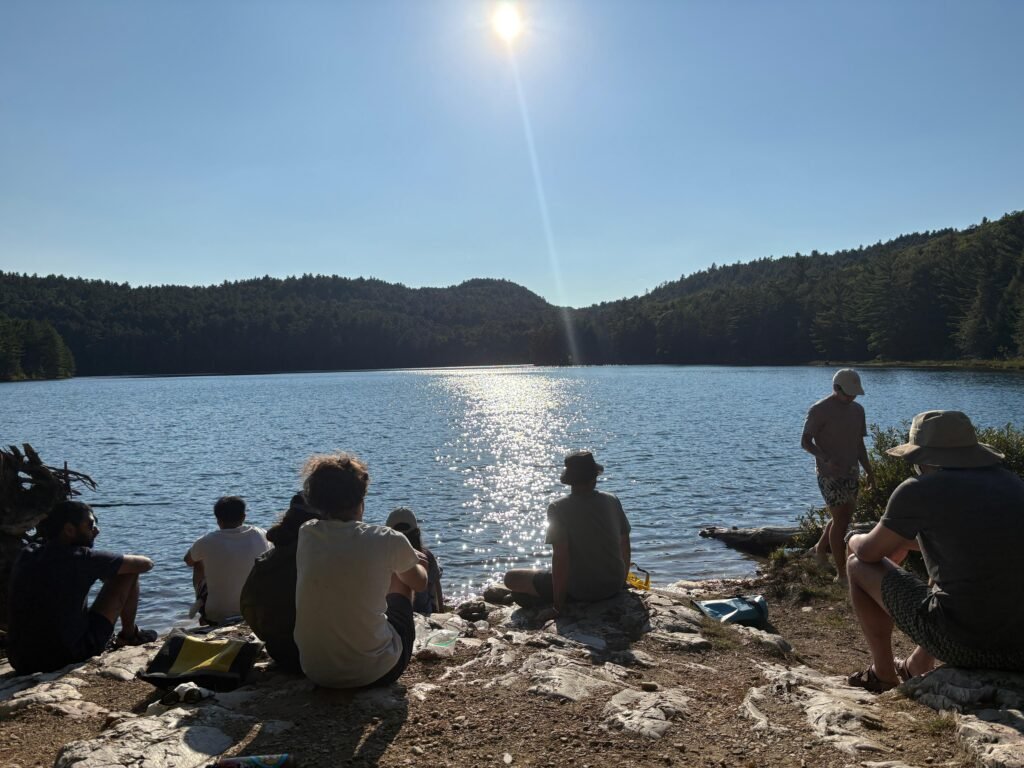
Otherwise, most of your time will be spent at camp. Swimming, short paddles, and just being out there. That’s kind of the point.
If you have time on the way in or out, the village of Killarney is a nice stop. It’s about 10 km from the park and known for fish and chips.
10: What Most First-Time Trips Get Wrong
Most first-time Killarney camping trips go wrong in the same few ways. The plan is usually too ambitious, the booking happens too late, or the campsite system isn’t fully understood. On top of that, travel time is almost always underestimated, especially once portages are involved.
If you keep your trip simple, most of that goes away. Pick an access point that makes sense, book a site you can realistically reach, and don’t try to do too much on your first trip.
Once you’ve done that once, everything gets easier.
If you’re planning more trips like this, or just looking for ideas on where to go next, you can explore more in my Canada travel guide.Affiliate box or any extra infomration that might be helpful.
