
Tbilisi is one of the oldest capitals in Europe, with a recorded history that goes back over 1,500 years, and visible layers of Persian, Arab, Russian, and Soviet influence still shaping its streets today.
When I spent a month living here, it wasn’t the major landmarks that stayed with me. It was the rhythm of the neighborhoods, the everyday rituals, and eventually, having a real opinion on where to find the best khinkali (everyone in Tbilisi has one).
This 3-day itinerary is designed for travelers who want to plan efficiently without rushing past the good stuff. You’ll explore the Old Town and fortress trails, discover street art and flea markets, and see how Tbilisi’s contradictions – elegant, gritty, post-Soviet, proudly Georgian are exactly what make it work.
About This Itinerary
About This Itinerary
Most travelers give Tbilisi three days – and that’s the structure I’ve followed here. But after living in the city for a month, I can say with confidence: it’s worth slowing down for.
This itinerary is designed to work whether you’re here for a short visit or planning a longer stay. You can follow it exactly, stretch it out, or swap days around depending on your pace. Each day includes a mix of big-name landmarks and smaller details – the kind of places that don’t always make the guidebooks but shape your experience just as much.
And while this is a 3-day plan, I’ve also included optional day trips and add-ons if you’ve got more time. Think of this as a base to build on, not a checklist to complete.
>> We ended up staying in Georgia for nearly 2 months, and the longer we stayed, the more the country opened up — here’s what it’s like for nomads.
Tbilisi in Context: Empires, Culture, and Contradictions
Tbilisi has been sacked, burned, and rebuilt so many times that you can see layers of empire etched into its streets. It was founded in the 5th century by King Vakhtang I Gorgasali, who supposedly discovered the area’s natural hot springs while hunting (Tbilisi means “warm place” in Old Georgian). Over the next 1,500 years, everyone from the Persians to the Mongols to the Soviets tried to claim it. Few succeeded for long.
That constant push and pull shaped more than just city walls. You see it in the tension between domed Orthodox churches and crumbling Soviet apartment blocks. In the way Stalin-era opera houses stand across from minimalist wine bars. In a single walk, you might pass a 6th-century basilica, a protest outside Parliament, and a grandmother selling herbs beneath a Brutalist overhang.
It helps to know: Georgia officially adopted Christianity in the 4th century, making it one of the oldest Christian countries in the world. Tbilisi became its capital a century later and has remained politically and culturally central ever since, even as it shifted between being a frontier outpost of the Persian Empire, a Silk Road trading post, and eventually a key Soviet city.
Today, over a third of Georgia’s population lives here, and you can feel that weight: the capital isn’t just where decisions are made, it’s where tensions simmer. Russian colonialism, economic inequality, and the country’s westward tilt all show up on its walls – literally, in many cases.
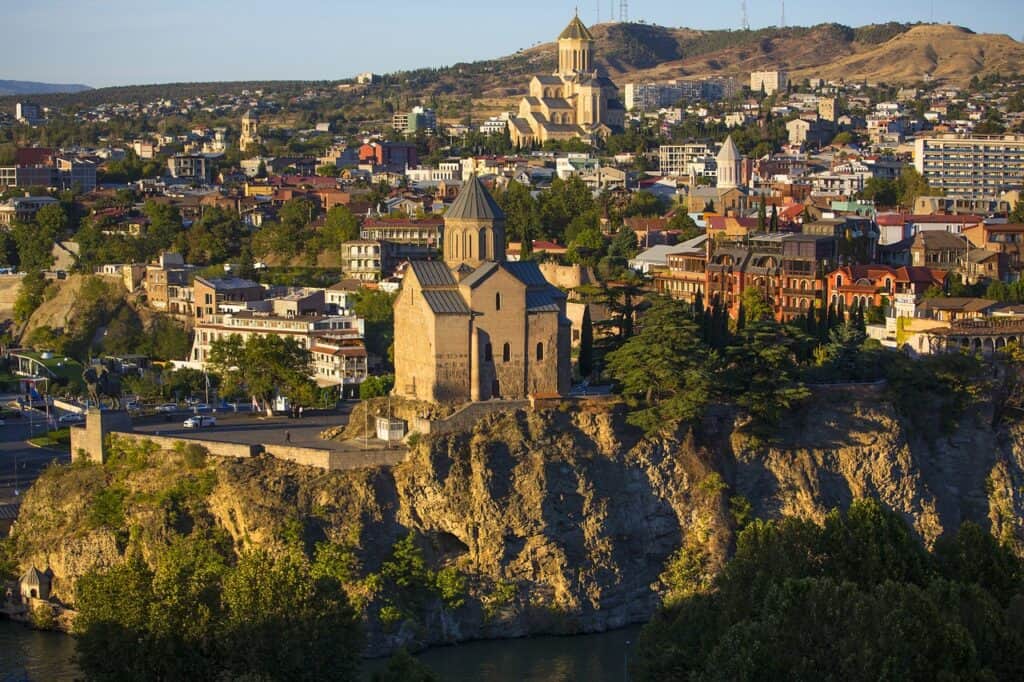
Day 1 – The Historic Heart of Tbilisi
Morning: Old Town Walkabout
Start your first morning in Tbilisi where most of its stories begin — the Old Town, or Dzveli Tbilisi. This part of the city has been built and rebuilt over centuries, and you’ll see the layers as you walk: medieval churches next to pastel balconies, Soviet leftovers across from glass hotels.
Begin near Liberty Square and wander toward the sulphur baths in Abanotubani. The area is compact, so you don’t need to follow a strict route. Just take your time walking the streets between Sololaki and the river.
Make time to stop at:
- Anchiskhati Basilica – The oldest surviving church in Tbilisi, dating back to the 6th century. It’s often quiet, with candles burning and occasional polyphonic chants echoing through the stone walls.
- Sioni Cathedral – This used to be the main cathedral of the Georgian Orthodox Church and still feels central. It’s more ornate than Anchiskhati, and often busier.
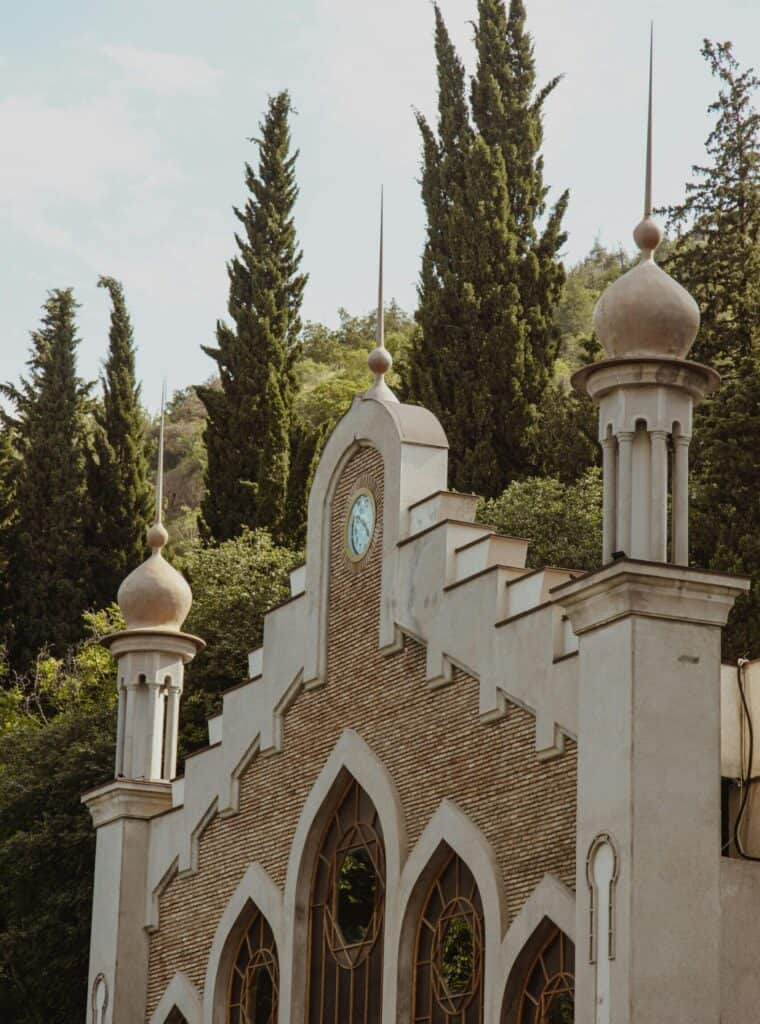
- Rezo Gabriadze Marionette Theater & Clock Tower – A strange little building with a slanted clock tower that’s become one of the city’s quirks. There’s a short puppet show at noon that’s worth catching if you’re nearby. It’s more for the photops than anything else.
- Stroll through Shardeni Street – After checking out the sights, head over to Shardeni Street. This is where the action is – lots of little cafés, bars, and shops to check out. It’s a great spot to grab a coffee, watch people, or try some local food. The street always feels lively, and you’ll find both locals and tourists hanging out here.
This is a good time to ease into the city without an agenda, just seeing what’s open, what smells good, and what makes you want to stop.
💬 Need help getting oriented?I always recommend starting any new city with a walking tour – especially one that’s run by locals who can give you context, not just directions. Check out this guided walking tour that covers many of the sights from Day 1, with some extra stories you won’t find on signs.

Afternoon: Fortress Views and Sulphur Baths
From the Old Town, make your way across the river to Rike Park and take the aerial tramway up to Narikala Fortress. The ride itself is quick and gives you a sweeping view of the city’s rooftops, the Mtkvari River, and the crumbling facades that make up central Tbilisi. If you’d rather go by foot, there’s a well-marked trail that starts behind the bathhouses—it’s a short but steep climb and gives you a good feel for the terrain.
- Narikala Fortress has been watching over Tbilisi since the 4th century, and while it’s mostly in ruins now, that’s part of the appeal – no turnstiles, no guards, just open stone walls and some of the best views in the city.
- Kartlis Deda (Mother of Georgia) – a 20-meter-tall statue holding a bowl of wine in one hand and a sword in the other. The symbolism runs deep: Georgians are famously warm and generous hosts, but they’ve also had to defend their land for centuries. This statue makes both points in one striking image.
- Abanotubani District (Sulphur Baths) – The trail down from the fortress winds you into Abanotubani, the sulphur bath district. This is the part of the city King Vakhtang I supposedly stumbled into while hunting, which led to Tbilisi’s founding. The smell of sulphur hits you before you see the domed rooftops. Whether or not you go in is up to you – the bath experience is a personal one. Some people love it, others find it overrated. If you’re curious, you can book a private room at one of the more modern bathhouses (like Chreli-Abano or Gulo’s), or just stick your head into one and decide later.
💧 Thinking of trying a bath?
This Sulphur Royal Pool experience includes a boutique wine tasting and private room with kisa scrub. If you’re curious but unsure, this is a clean, comfortable intro to the tradition—without the awkwardness.
>> Book it here
Evening: Dinner Near the Baths
By now you’ve earned a slow evening. You’ll already be in Abanotubani, which is one of the best areas in the city for dinner – atmospheric, historic, and full of great Georgian restaurants.
A few local favorites nearby:
- Culinarium Khasheria – A modern take on Georgian cuisine right next to the baths. They’re known for creative plating without being pretentious.
- RIGI – Great for upscale traditional food with a cozy feel. It’s a quieter spot, good for decompressing after a full day.
- Pasanauri (Bath District branch) – Classic, casual, and consistently good. This is a solid spot to try khinkali if you haven’t already started ranking your favorites.
If you’re up for a short walk after dinner, head over to Shardeni Street or along the river toward Metekhi Bridge – both areas stay lively well into the evening.

Day 2: Markets, Museums & Mountaintops
Morning: Dry Bridge + Rustaveli
Start your second day with a stroll through one of Tbilisi’s most peculiar and charming open-air markets: the Dry Bridge Market. It sprawls across the riverbank like someone turned their attic inside out—vintage cameras, mismatched cutlery, faded Soviet pins, World War II medals, broken chess sets, portraits of Stalin, lace doilies, and the occasional full set of teeth in a jar (I wish I was kidding).
I wouldn’t call it a must-buy kind of place, but it’s a must-browse. Some vendors are ex-architects or artists trying to make ends meet, and the mix of memorabilia and melancholy gives it a certain weight. It’s touristy now, sure, but still very much local.
From here you have a few options:
- Rustaveli Avenue, Tbilisi’s grandest boulevard. It’s a very “capitals of the 19th century” kind of street: ornate facades, balconies with peeling paint, and a mix of pride and decay. Walk past the Parliament building, the Opera House, and a few overpriced cafes that try to pass themselves off as Viennese.
- Georgian National Museum – If you’re more cultured than I am, this is the place to go. The permanent collection covers everything from ancient goldwork to Soviet propaganda. Expect some serious curation, and not much air conditioning.
Afternoon: Funicular to Mtatsminda
After a slow morning of markets and museums, switch things up with a ride up to Mtatsminda Park, perched on the hill that looms over the city. You can get there by funicular, which departs from Chonkadze Street and takes you up in a steep, creaky cabin that feels halfway between charming and mildly alarming. It’s the kind of ride where everyone pretends they’re chill while low-key watching the cables.
We went up around sunset and it was one of those weirdly memorable travel moments—empty rides, pink skies, and a definite Joyland vibe (for my Lahori readers). It’s no Six Flags, but that’s not really the point. Mtatsminda Park has a sort of faded charm: rusty rides, overpriced snacks, teenagers on dates, and enough open space to catch your breath above the noise of the city. We were the only ones on one of the rides, and somehow that made it even better.The viewpoint at the edge of the park is one of the best in Tbilisi, especially at golden hour. You’ll see the river curling through the city, Soviet blocks lined up like dominoes, and if the sky’s clear, the Caucasus Mountains holding the horizon.
Evening: Cooking Class or Dinner Out
By now you’ve walked a lot, browsed a lot, and probably formed some strong opinions about Georgian food. If you want to level up from just eating khinkali to actually understanding it, this is the perfect night for a cooking class.
I didn’t do one while I was in Tbilisi, and honestly, I regret it. I kept thinking, I hate cooking, why would I spend vacation time learning to cook? Fast forward to living in Toronto, where there are exactly two Georgian restaurants in a city that claims to have everything, and suddenly I’m craving khinkali like it’s an emotional support dumpling.
If you’re even a little curious, this is the kind of experience you’ll remember long after the trip.
🍴 Learn to cook Georgian classics
Hands-on class making khinkali and khachapuri with local instructors. Fun, social, and a great way to understand the food instead of just inhaling it.
>>> Book the cooking class here
If cooking isn’t your thing (no judgment, truly), spend the evening exploring neighborhoods a little beyond the Old Town. Vera and Marjanishvili are great areas for dinner – less touristy, more local, and full of small restaurants and wine bars where menus are short and portions are generous.
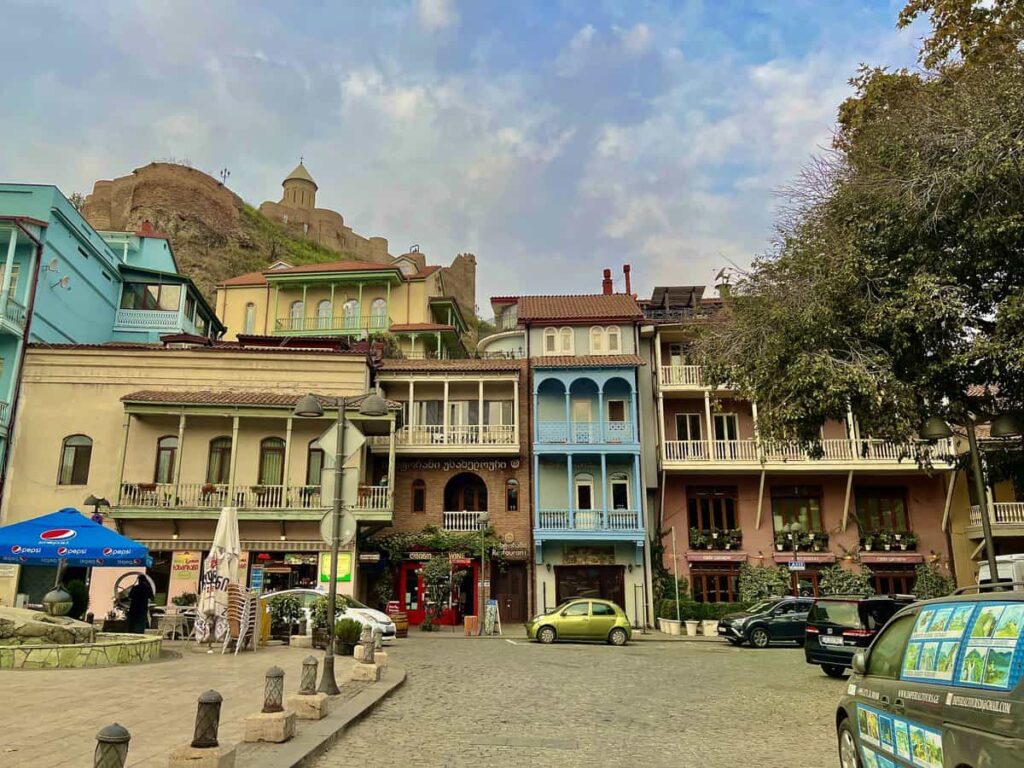
Day 3: Alternative Tbilisi
If you’ve seen the churches and soaked in the baths, today’s a chance to see a different side of Tbilisi – one that doesn’t show up in glossy brochures but tells you a lot about how the city actually moves.
- Marjanishvili – start your morning in this neighborhood with a layered past and a low-key coolness that grows on you. This part of the city was shaped by Tbilisi’s Armenian and German communities in the 19th century and today still feels different from the Old Town. The buildings are blockier, the sidewalks wider, and the vibe more residential. You’ll find Turkish bakeries next to third-wave coffee shops and soviet mosaics above vintage stores. I liked Entrée and Stamba Café for long breakfasts and people-watching.
- Chronicles of Georgia – A Bolt ride out of the city drops you to this massive, half-forgotten monument overlooking the Tbilisi Sea. It’s one of the most surreal places I’ve ever been: giant black columns etched with scenes from Georgian history and the life of Christ, standing like a stonehenge-meets-Soviet-sci-fi mashup. There’s rarely anyone else around, which only adds to the strangeness. It’s both nationalistic and obscure, symbolic and unfinished. A lot like Georgia itself.
- Sameba Cathedral – Officially known as the Holy Trinity Cathedral of Tbilisi, this is the biggest church in the country and one of the tallest Orthodox churches in the world. It’s flashy and over-the-top, a kind of spiritual flex built after independence.
- If you’re staying longer in the city, keep an eye out for traditional dance shows, underground music gigs, or screenings at Amirani Cinema. Tbilisi’s creative scene is scrappy but full of life.
Day 4 (optional): Day Trips from Tbilisi
If you’ve got an extra day in Tbilisi, two of the best day trips are east to the wine region of Kakheti, or north into the Caucasus mountains around Kazbegi. They’re very different experiences—one for food and culture, the other for landscape and altitude.
Option 1: Kakheti Wine Region
Georgia’s wine history goes back over 8,000 years, and Kakheti is where it all started. I did this day trip and absolutely loved it. We met at a central point in the city and spent the day visiting small, family-run wineries that poured generous tastings and actually explained what made each bottle different.
You’ll learn about both traditional qvevri winemaking (fermenting in clay pots underground) and modern techniques, and taste everything from dry reds to sweet whites to chacha and cognac. It’s broad, well-paced, and surprisingly fun even if you’re not a wine nerd. Eat a solid breakfast—this is not a “just one glass” kind of tour.
A stop at the Monastery of St. Nino at Bodbe adds a quiet moment and a great view over the Alazani Valley.
🍷 Taste Georgia’s oldest tradition
Two family-run wineries, generous tastings, and a stop at Bodbe Monastery. Warm, local, and well worth the day.
>>> Book the wine day trip here
Option 2: Kazbegi & the Caucasus Mountains
This is the easiest way to get a taste of Georgia’s mountain landscape without renting a car. The day trip covers a lot of ground—winding roads, high-altitude views, and some of the country’s most iconic stops.
Most tours include:
- Ananuri Fortress – A medieval complex on the edge of the Zhinvali Reservoir.
- Gudauri Viewpoint – A high-altitude lookout with panoramic views of the Caucasus.
- Gergeti Trinity Church – Perched on a hill with Mt. Kazbek rising behind it. Feels remote, even when there’s a crowd.
There’s usually a stop in Mtskheta on the return, Georgia’s former capital and an easy place to pick up souvenirs or a final church photo.
One note: the tunnel to Kazbegi sometimes closes due to weather or traffic. Most tours reroute as needed, but it’s worth checking conditions in advance.
🏔 See the Caucasus without a car
A packed but well-organized day covering mountain roads, historic sites, and incredible views.
>>> Book the Kazbegi tour here.
Where to Stay in Tbilisi
There are a lot of good hotels in Tbilisi, but if I had to narrow it down, here are three I’d recommend based on different styles and budgets — whether you want cozy, cool, or all-out comfort.
- Makmani Boutique Hotel (Liberty Square) | Perfect for first-timers. It’s got a classic Georgian look, quiet charm, and an unbeatable location — right in the city center but tucked away from the chaos. You can walk to most sights from here.
- Fabrika (Chugureti) | This is the artsy, social option. A former sewing factory turned hostel-hub, with private rooms, cafés, and a courtyard full of pop-ups and street art. It’s affordable, fun, and a little outside the tourist bubble.
- Radisson Blu Iveria (Rustaveli Avenue) | If you’re after something more upscale, this is your spot. Reliable, modern, with a killer spa and views over the city. Great if you’re mixing business with leisure — or just want a break from character-building accommodation.
How to Get Around Tbilisi
The city’s compact, and you’ll probably walk more than anything else. But here’s how to get around when your legs give up:
- Metro – Two lines, fast and dirt cheap. Use a MetroMoney card or just tap your credit card at the gates. Stations are deep, Soviet, and sometimes confusing — use Google Maps for directions, but don’t trust walking routes inside stations.
- Bolt – Easiest ride-hailing app here (don’t bother with Uber). Reliable and affordable, though traffic can be brutal during rush hour.
- Marshrutkas – These yellow minibuses run fixed routes and take cash only. Fun once, but hard to navigate if you don’t speak Georgian or Russian.
Tbilisi Grows on You
Tbilisi wasn’t love at first sight for me but it didn’t have to be. It’s the kind of place that slowly reveals itself in layers: a cracked façade here, a perfect khinkali there. The longer you stay, the more it rewards you.
If you’ve only got a few days, use this guide to ease into it. But if you can spare more time, I’d strongly recommend it. Georgia has a way of getting under your skin, and not just in Tbilisi. The further you go, the deeper it gets.📍If you’re thinking of extending your trip, this hike from Mestia to Ushguli in the Svaneti mountains is one of the most stunning trails I’ve ever done – worth planning your whole trip around.
Frequently Asked Questions
How many days are enough in Tbilisi?
A minimum of three days is enough to get a good feel for Tbilisi, but you can easily spend more time here exploring its many neighborhoods, historical sites, and food spots. If you prefer a slower pace, stretching your stay is a great idea.
Is Tbilisi better than Batumi?
Yes, I found Tbilisi to be much more authentic compared to Batumi, which felt more like a tourist-made destination. Tbilisi offers a deeper cultural experience and a unique blend of history and modern life.
Is it expensive to visit Tbilisi?
Visiting Tbilisi can suit a range of budgets. For budget travel, expect to spend around $30-40 per day. Mid-range travelers might spend $60-80 per day, while high-end travelers could spend $150+ depending on accommodation and dining choices.
