Mount Robson has been on my list since I moved to Canada.
Every hiker I met, every Canadian hiking forum I fell down way past my bedtime, every “best backpacking trips in the country” roundup – this trail kept coming up. Mount Robson Provincial Park is BC’s second oldest provincial park and home to Mount Robson itself, the highest peak in the Canadian Rockies at 3,954 metres (12972 ft). After doing it, I get why it keeps coming up.
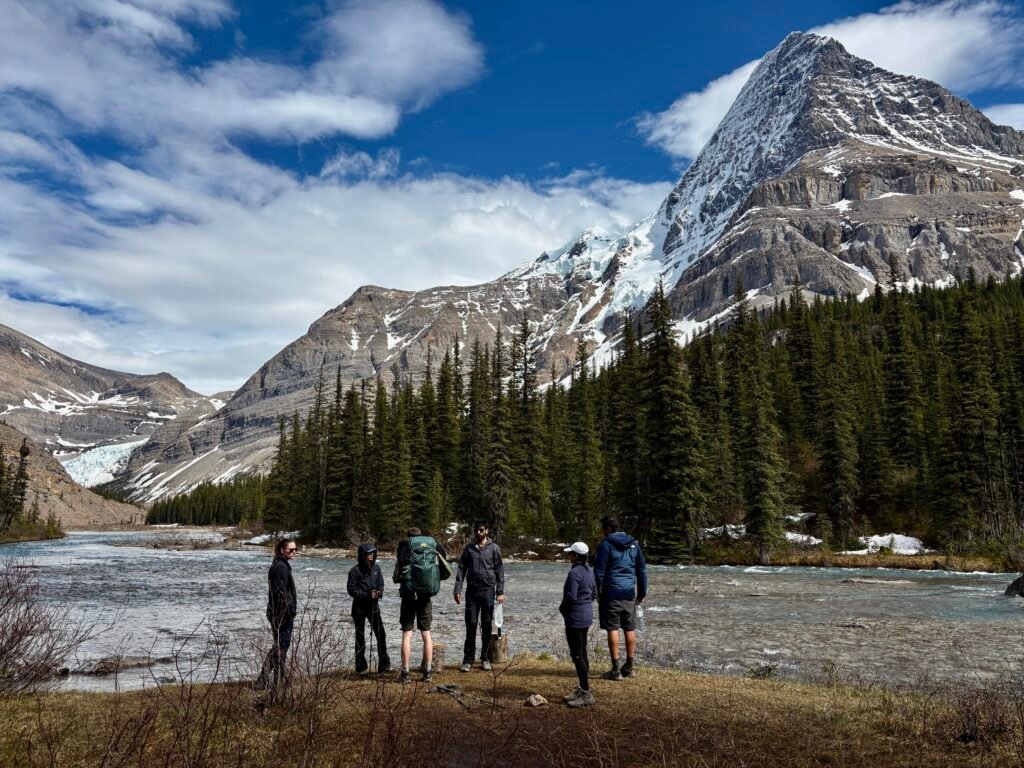
What made this one special wasn’t just the trail. My two siblings, a friend from Copenhagen, two from New York, one from Seattle – everyone showed up for this one. Being in the mountains with people you love is not something I take for granted.
The Berg Lake Trail is a 22km route from the Mount Robson Visitor Centre to Robson Pass, passing 7 campgrounds, glacial rivers, waterfalls, and eventually Berg Lake itself – turquoise, glacier-backed, with an active glacier calving directly into it. Most people do it over 3 to 5 days. We did 4 and I’d recommend every single one of them.
Fair warning: the permit system is competitive. Spots fill fast, the booking process has a few non-obvious steps, and if you miss the window, you’re day hiking. This guide covers all of it – permits, campgrounds, the full route breakdown, where to stay, and my honest experience from start to finish.
Quick Facts: Berg Lake Trail
- Trail name: Berg Lake Trail
- Location: Mount Robson Provincial Park, British Columbia
- Total distance: 23km (14m) one way / 46km (28m) return
- Elevation gain: ~800m (2625ft) (AllTrails lists this as 1,500m. The actual gain is closer to 800m, so don’t let that number put you off)
- Difficulty: Moderate to strenuous
- Highest point: Robson Pass at 1,649m (5,410ft)
- Trail type: Out and back
- Average hiking time: 3 to 5 days
- Campgrounds: 7 (Kinney Lake, Whitehorn, Emperor Falls, Marmot, Berg Lake, Rearguard, Robson Pass)
- Permit required: Yes, for all overnight stays between May 26 and September 29
- Best season: July to September
- Cell service: None from the trailhead onwards – plan accordingly
- Dogs allowed: Yes for day hikes, not for overnight stays
- Fires: Not permitted anywhere on the trail
Best Campgrounds to Book
There are 7 campgrounds along the Berg Lake Trail with 103 tent pads total. Here’s what you need to know to make your booking decision.
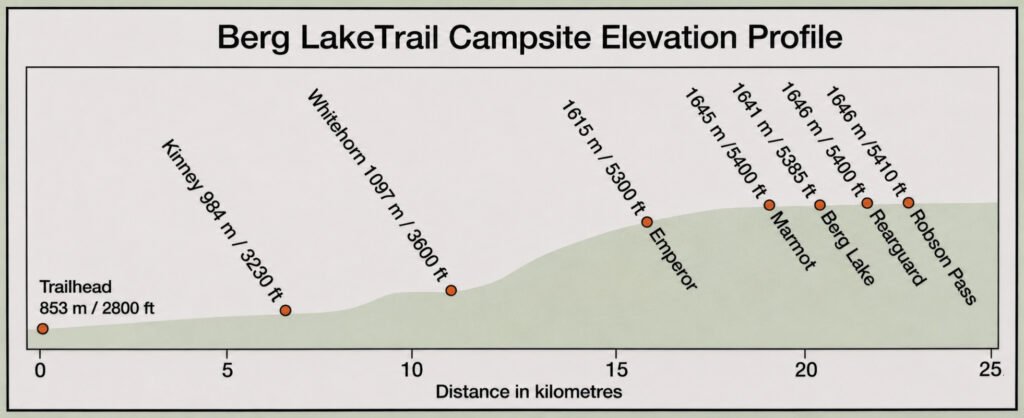
Kinney Lake | 984m / 3,230ft | 18 tent pads | 6.5km from the trailhead.
Great for families, beginners, and anyone wanting to split the hike. Lakeshore access and shelter on site. Bikes and strollers allowed on this section.
Whitehorn | 1,097m / 3,600ft | 22 tent pads | 10.5km from the trailhead.
The largest campground on the trail. Good midpoint stop that makes the push to Berg Lake much more manageable. Riverside location, shelter with woodstove.
Emperor Falls | 1,615m / 5,300ft | 9 tent pads | 15km from the trailhead.
Smaller and less private but a smart stop if you want to get the hardest climbing done on day one.
Marmot | 1,645m / 5,400ft | 7 tent pads | 17.5km from the trailhead.
Small, quiet, well-equipped. Some tent pads have glacier views. Good base for Berg Lake area day hikes.
Berg Lake | 1,641m / 5,385ft | 26 tent pads | 19.5km from the trailhead.
The most popular campground for good reason. Best lakeshore access, most facilities, century-old Hargreaves Shelter on site. Book this one first.
Rearguard | 1,666m / 5,400ft | 6 tent pads | 20.5km from the trailhead.
Small and quiet, 1km from Berg Lake along a flat trail. Good alternative if Berg Lake is fully booked.
Robson Pass | 1,649m / 5,410ft | 15 tent pads 21.5km from the trailhead.
The furthest campground, right at the BC/Alberta border. There is also a hostel-style cabin available for around $50/night here – apparently a nightmare to book but worth trying.
🚁 You can also fly into Robson Pass by helicopter from town on Mondays and Fridays – one way only, not out. We met two sisters who’d flown in and were hiking back down. Not gonna lie, I was a little jealous.
Getting to Mount Robson
Mount Robson Provincial Park sits on the BC/Alberta border, right on Highway 16 between Valemount and Jasper. The trailhead is directly behind the Visitor Centre.
A car is essentially non-negotiable. Public transport to the park is extremely limited and no nearby town is walkable to the trailhead. If you’re flying in without a car, renting is your best option.
🚗 When comparing rental prices, I usually check Discover Cars first since it aggregates different companies and sometimes ends up cheaper than booking directly. We ended up with Budget, but another company was cheaper the week before.
From Edmonton: Around 5 hours – this is the route we took. You drive through Jasper on the way, which is worth a stop for lunch or an overnight if you haven’t been. It’s a lovely mountain town and a good way to break up the drive.
From Calgary: Around 6 to 7 hours depending on your route.
From Vancouver: Around 7.5 to 8 hours. Long but doable as part of a bigger BC road trip.
From the US: My friend drove up from Seattle – factor in around 8 hours plus border crossing time.
✈️ Flying from Toronto? I’ve got guides to things to do and where to stay if you want to extend your trip.
⏰ Mount Robson Provincial Park runs on Pacific Time, which is one hour behind Alberta. If you’re driving in from Edmonton or Jasper, you’ll actually gain an hour when you cross into the park. We didn’t realise this on the drive and it was a nice surprise. Worth keeping in mind for permit pickup timing and general planning – especially since Jasper and Banff operate on Mountain Time.
Parking
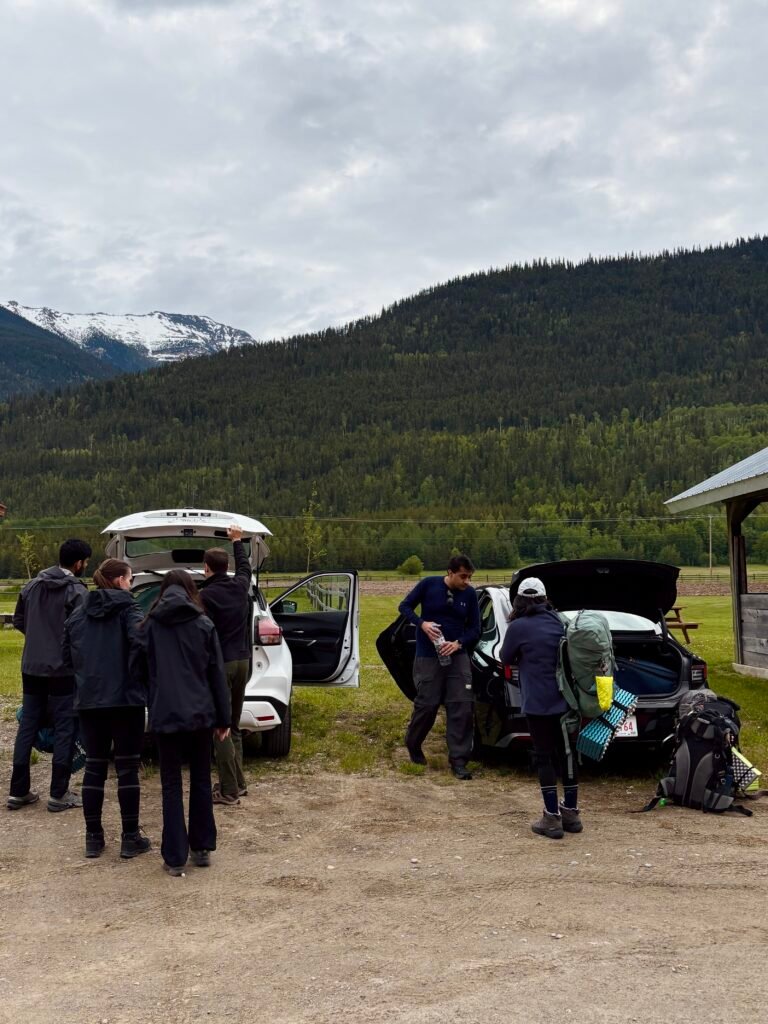
There’s a large parking lot at the Visitor Centre right at the trailhead. It’s free. One tip from the rangers when we checked in: don’t leave anything in your car that suggests you’ll be away for multiple days.
Best Time to Hike Berg Lake Trail
July and August are the sweet spot. Wildflowers, long daylight, the best weather. August can bring wildfire smoke but it’s not guaranteed. This is also the time when Snowbird pass is open. September is underrated – fewer crowds, fall colours, cooler temps.
In June snow is still clearing on upper sections, river crossings can run high, and the bugs are waking up.
We went at the end of May. The drive up was wet enough that we stopped in Jasper for extra ponchos. On the trail we got cloudy hiking days, some rain on rest day where we huddled in a tent and had some of the best conversations we’d had, and sunshine on the last day out. Not bad. The mountains are unpredictable regardless of when you go – prepare for the worst and anything better is a bonus.
The trail opens around May 26 and permits are required through September 29. Outside that window it’s open year-round for winter day hikes, first-come, first-served at Kinney Lake and Whitehorn only.
*Cancellations happen quite frequently, especially for shoulder season. If your first booking attempt comes up empty, keep checking.
Getting a Permit
Permits for the Berg Lake Trail are competitive. This is one of the most well-known backpacking trails in Canada, and following a major flood in 2021 that closed the trail for four years, demand is higher than ever. The trail only fully reopened in late June 2025.
Do You Need a Permit?
If you’re camping overnight between May 27 and September 29, yes. No exceptions.
Day hiking doesn’t require a permit. People day hike all the way to Berg Lake and back, it’s a long day but it’s done regularly.
When Reservations Open
Reservations open on a single date in December – for the 2026 season this was December 2, 2025 at 7AM PST. Everything releases at once, so you need to be ready.
- BC Parks announces the exact date 1-2 weeks in advance on the Mount Robson Provincial Park page and their Instagram.
- Create your BC Parks account before the date and have your group details ready.
- Have a backup itinerary. If your first choice campsite is gone in the first five minutes, you need to pivot immediately.
- If you’re not successful right away, wait 15–20 minutes after the launch – many people hold spots in their baskets while conferring with their group. Some availability reappears once those holds expire.
- You can also keep checking for cancellations in the weeks before your trip if you have a flexible itinerary.
How to Book
Book online at camping.bcparks.ca. Select ‘backcountry,’ then ‘Berg Lake Trail.’ You’re booking specific tent pads at specific campgrounds, so have your full itinerary planned before you sit down.
- There are 103 tent pads available across all 7 campgrounds each night.
- Each tent pad fits up to 2 tents and 6 people. If your group has more than one tent, I would recommend booking a separate pad per tent.
- You can reserve up to 2 tent pads at once, for a maximum party of 12.
- Booking by phone costs an extra $5. Do it online.
💸 Cost: $10 CAD per person per night + $6 reservation fee per night for the first three nights (maximum $18 total reservation fee per booking). Check BC Parks directly for any additional fees.
Picking Up Your Permit
All Berg Lake Trail campers must check in at the Mount Robson Welcome Centre before starting the hike. You’ll receive a laminated pink card with your reservation details on one side and a map on the other. Hang it outside your tent at every campsite so rangers can check it easily.
The Welcome Centre is open from 8AM to 4PM daily during operating season. I’d recommend checking in the day before your hike, not the morning of. Between 8-10AM on hiking days the centre gets chaotic, with everyone trying to check in before hitting the trail. Going the afternoon before is much calmer and means nothing delays your early start.
A few things from our experience:
- Not everyone needs to be present at check-in. We had 11 people and only 5 showed up first. The staff confirmed everyone was adults and we were good to go. That said, policies may vary so don’t bank on this.
- We were told we had to watch an orientation video but that wasn’t the case.
- The staff will update you on current trail conditions. When we checked in, we were told there would be snow and ice on the upper sections of the trail. Someone in our group had also seen an AllTrails comment warning about steep snow. We debated getting gaiters. In the end the snow had melted by the time we got up there – but conditions vary, especially early season.
- The Welcome Centre has free wi-fi – useful before and after the trail since there is zero phone signal from the trailhead onwards
- Don’t leave anything in your car that suggests you’ll be away for multiple days. Tip straight from the rangers
- Check the BC Parks Mount Robson advisories page for current trail conditions before you go
Where to Stay Before and After Your Hike
Before the Hike
You need to be within reach of the Visitor Centre the day before your hike – remember, permit pickup closes at 4PM. Valemount is the closest town, about 20 minutes from the trailhead.
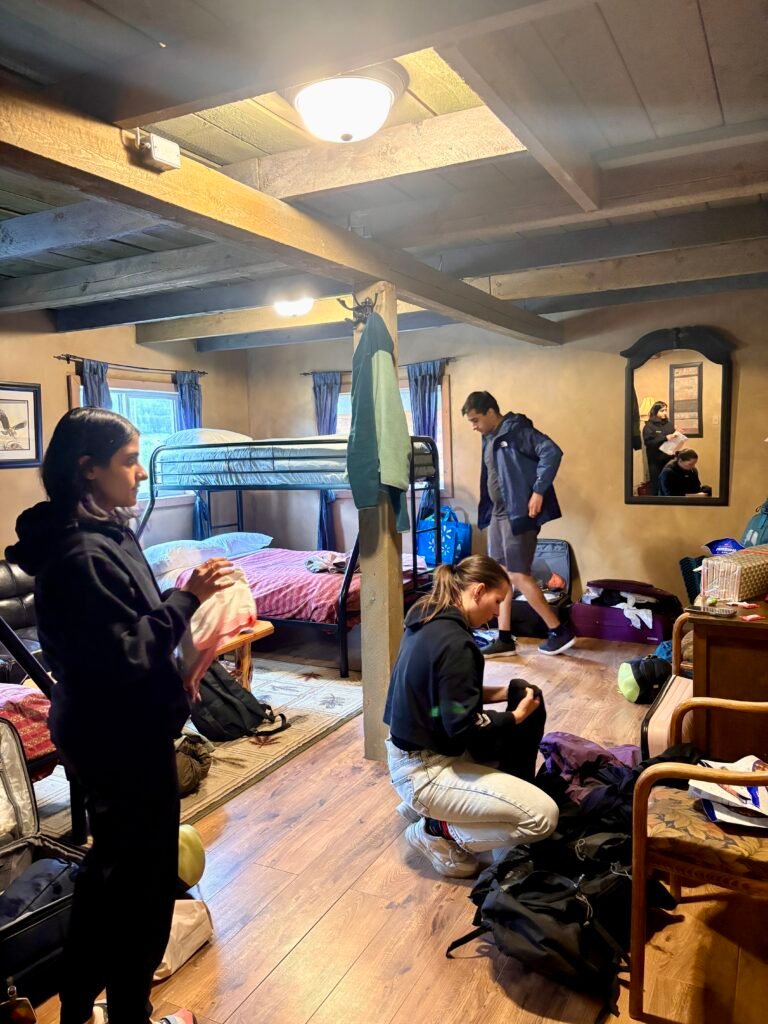
Terracana Ranch Resort | This is where we stayed and I’d go back without hesitation. It’s a ranch-style property surrounded by mountains, with cows grazing in the field across the road. We booked a large cabin with bunk beds for our group of 11 — it worked perfectly, and there are other room options if you’re not traveling in a herd. No breakfast, but there’s a cookout area which is great if you want to prep your trail food the night before. It’s away from any crowds or noise, genuinely relaxing, and exactly what you want the night before a big hike. I wish we’d had more time there.
After the Hike
You’re going to come off that trail wanting a hot shower, a real meal, and ideally something to soak your legs in.
Comfort Inn Valemount | Straightforward, affordable, gets the job done. What I wasn’t expecting was the sauna and hot tub, which after 4 days on trail felt like the greatest luxury known to mankind.
For dinner, walk to Glacier Fire Pizzeria in town. Just do it.If you want more amenities and things to do around you, Jasper is about an hour’s drive and worth considering – especially if you’re making a longer trip of it. It’s one of my favourite towns in Canada, with good restaurants, beautiful surroundings, and plenty to keep you busy before or after the trail.
Berg Lake Trail Route Breakdown
The Berg Lake Trail runs 22km one way from the trailhead at the Mount Robson Visitor Centre to Robson Pass. What makes this trail special is that it earns its views almost immediately and never really stops delivering. Below is a section by section breakdown of what to expect.
Trailhead to Kinney Lake
Distance: 6.5km | Elevation: 984m at Kinney Lake | Time: ~1.5 to 2 hours
This first stretch is the most manageable of the entire trail – and more beautiful than you’d expect for an opening act.
You cross a bridge over the Robson River right at the trailhead and you’re off. The path is wide – enough room for bikers and hikers – and follows the Robson River through dense cedar and hemlock forest. It almost feels like a rainforest. Huge leaves on everything, towering trees, thick undergrowth. Not what you’d expect in the Canadian Rockies but it sets a tone immediately.
Within the first kilometre we hit an avalanche field we had to cross. A nice way to ease into the hiking spirit. That was late May though – conditions will vary depending on when you go.
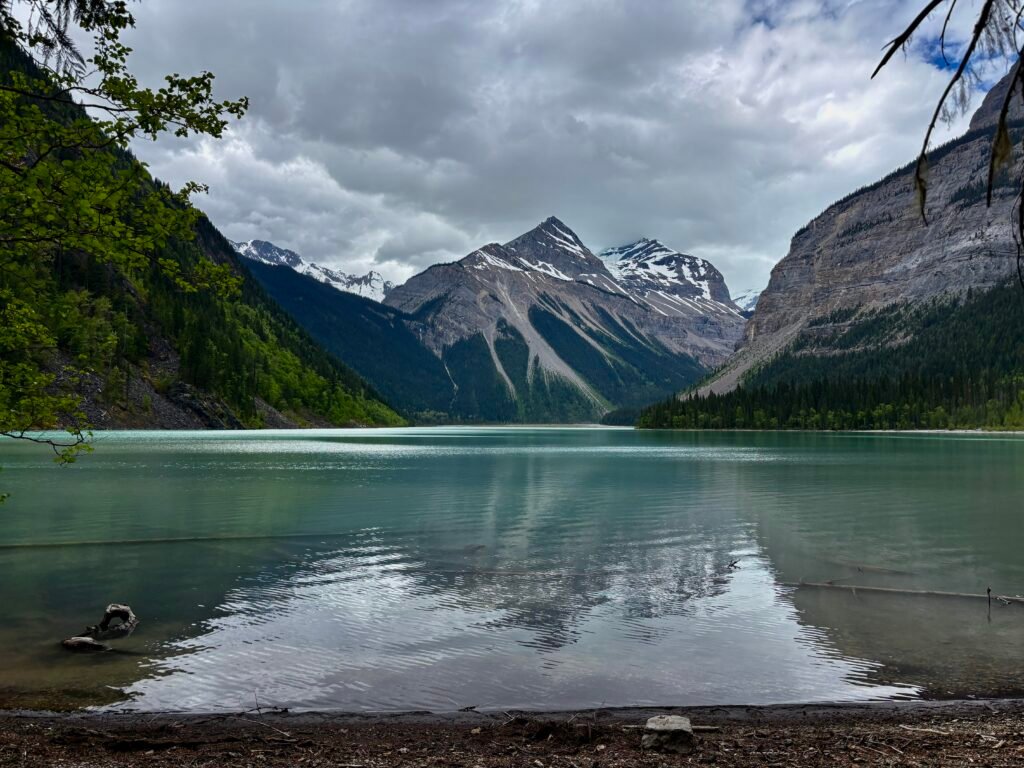
The trail stays relatively flat with gentle rises, the river running alongside you for most of it. Eventually the forest opens up and Kinney Lake appears. Mount Robson looming in the background, the lake perfectly still in front of it. We stopped here for a while. Hard not to.
Bikes are allowed on this section up to Kinney Lake, where there are racks at the far end. We started at 6AM on a Sunday with a storm forecast and had the trail almost entirely to ourselves. On the way back down it was a completely different story, day hikers with lunch bags, families, people in jeans. Peak season this section will be busy. Going early gives you a very different experience of it.
At the end of Kinney Lake you have two route options: the high route through the forest or the Kinney Flats route along the lakeshore. We took the high route going up and the Flats on the way back. Take the Flats, it’s more scenic, easier, and saves unnecessary elevation gain.
Kinney Lake Campground sits right here – 18 tent pads, lakeshore access, shelter on site. A genuinely lovely place to camp if you’re splitting the hike or want an easy overnight if you’re starting your hike later in the day.
Kinney Lake to Whitehorn Campground
Distance: 4km | Elevation: 1,097m at Whitehorn | Time: ~1.5 hours
Once you leave Kinney Lake the day hikers thin out fast. The path narrows and you begin gaining elevation steadily through forest. At the end of the lake there’s a junction with bike racks, this is where cyclists lock up and continue on foot.
The Valley of a Thousand Falls starts revealing itself gradually as you climb. When we came through in late May most of those falls were still frozen. In July or August you’ll get the full picture – waterfalls cascading down steep forested walls on every side. Even without them the scale of the valley is impressive.
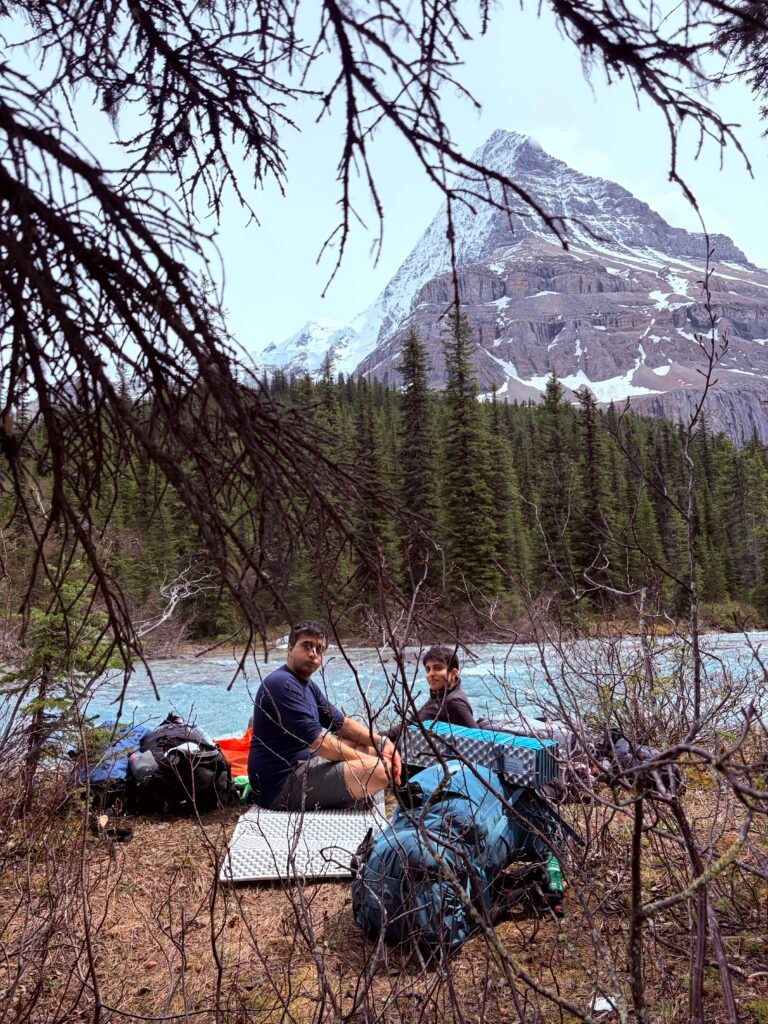
The river runs rocky alongside sections of this stretch. On a warm day it’s a genuinely nice spot to stop, wash your face, cool down. We took a longer break at Whitehorn by the river and it was exactly what we needed before the next section.
You know you’re close to Whitehorn when you hit the bridge just before the campground – this used to be a suspension bridge, now rebuilt as part of the 2025 trail reconstruction. Cross it and you’re there.
Whitehorn Campground has 22 tent pads – the largest on the trail. Situated right on the Robson River with views of the Valley of a Thousand Falls. A smart overnight stop if you want to break the hike into manageable sections but not my favourite campsite.
Whitehorn to Emperor Falls Campground
Distance: 4.5km | Elevation: 1,615m at Emperor Falls | Time: ~ 3 hours
This is where the trail earns its reputation.
From Whitehorn, the reconstructed trail starts with a bridge crossing and follows a traverse beneath a rocky slope. The path is well graded and mostly flat for the first stretch, with the Valley of a Thousand Falls opening up around you. It’s one of the most scenic sections of the entire trail and it eases you in gently before the real work begins.
Then you hit the yellow Rockfall Area sign. That’s your cue.
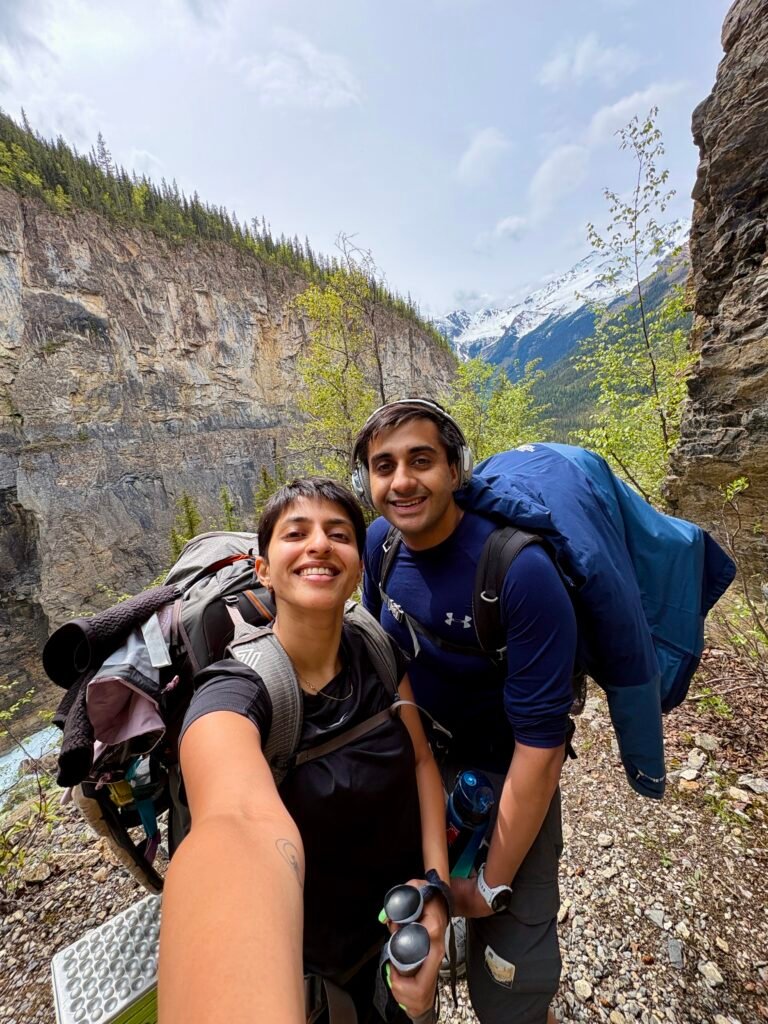
The climb from White Falls base to Emperor Falls campground is about 3.5km with around 500m elevation gain. Continuous switchbacks, steep rocky terrain, roots, some mud after rain. Between kilometres 13 and 14 it gets particularly steep and rocky.
Honestly, it wasn’t as hard as I was expecting. I had put some work into my cardio before this trip and I packed smarter than I have on previous hikes. Both of those things paid off here.
On the way up you’ll hear White Falls before you see it. A side trail leads to a rocky viewpoint overlooking the waterfall – we caught a rainbow there on the way up, which felt like a reasonable reward for the climbing.
We didn’t stop at Emperor Falls viewpoint on the way up. We were focused on getting to camp. We stopped on the way back down and I wasn’t prepared for how dramatic it is. It’s a 150m detour off the main trail, mostly downhill on the way there. The waterfall is enormous, and if you get close enough it mists you completely.
Emperor Falls campground sits just beyond – river views, Mount Robson visible in the background on clear days, and the satisfying feeling of having the hardest climbing behind you.
Emperor Falls Campground has 9 tent pads. Smaller and less private than other campgrounds but a smart stop if you want to tackle the toughest section on day one.
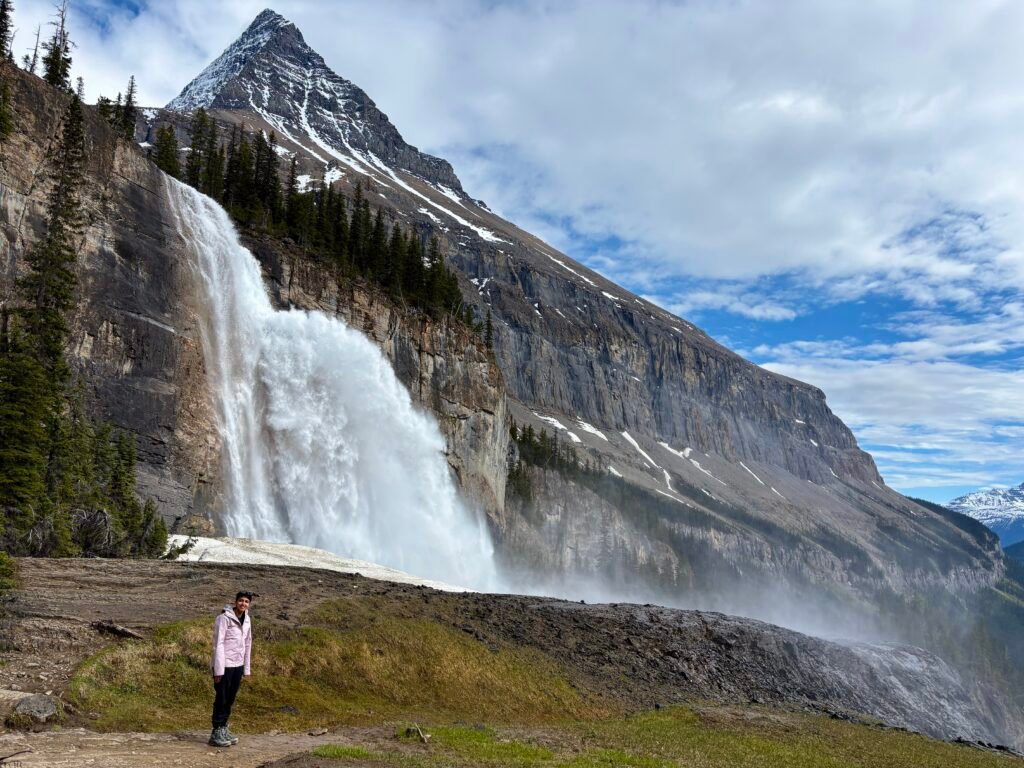
Emperor Falls to Marmot Campground
Distance: 2.5km | Elevation: 1,645m at Marmot | Time: ~ 1 to 1.5 hours
After the relentless climb to Emperor Falls, this section feels like a reward.
The terrain shifts completely here. Less than 200m from Emperor Falls campground, Mount Robson’s snowy north face comes into view for the first time – the Mist Glacier cascading down its rocky slopes.
The path winds along the bottom of a talus slope, the route protected by an intricate retaining wall built during the 2025 reconstruction. Then the trail opens up to a a rock hopping section across a series of large, carefully placed boulders over the river flats near Berg Lake’s outlet. About 600 metres of it. Most rocks are flat and dry in good weather, a few are uneven or partially submerged so watch your footing. It’s the kind of terrain that makes you feel like you’re actually in the wilderness rather than just walking through it.
This is also where the Berg Glacier comes into full view for the first time. Turquoise water, ice, rock – the landscape has completely transformed from the forested valley you started in that morning.
Marmot Campground is tucked into the trees nearby – 7 tent pads, some with glacier views, large shelter on site. Small, quiet, and well equipped.
Marmot to Berg Lake Campground
Distance: 2km | Elevation: 1,641m at Berg Lake | Time: ~30 to 45 minutes
The shortest section of the trail and arguably the best.
From Marmot it’s a straightforward 2km walk along a gentle shoreline path. The turquoise water of Berg Lake comes into view gradually and then all at once — and when it does, you stop walking. Everyone does.
Berg Lake is everything the trail has been building towards. The water is an impossible shade of turquoise. The Berg Glacier descends directly into it from the slopes of Mount Robson above. If you’re lucky you’ll hear the glacier calving – a deep crack and rumble that echoes across the lake. We sat there for a full hour, one hour away from our campsite, completely unbothered about getting there.
On the south side of Toboggan Creek you’ll find the Hargreaves Shelter, a century-old enclosed shelter with a woodstove and picnic tables inside. When we came back down on day three we sat inside, ate, and just looked out at the lake for a while. There’s also a covered porch area if the inside feels too enclosed.
This is the highlight of the entire trail.
Berg Lake Campground is the largest on the trail with 26 tent pads and the best lakeshore access. Book this one first – it goes fastest.
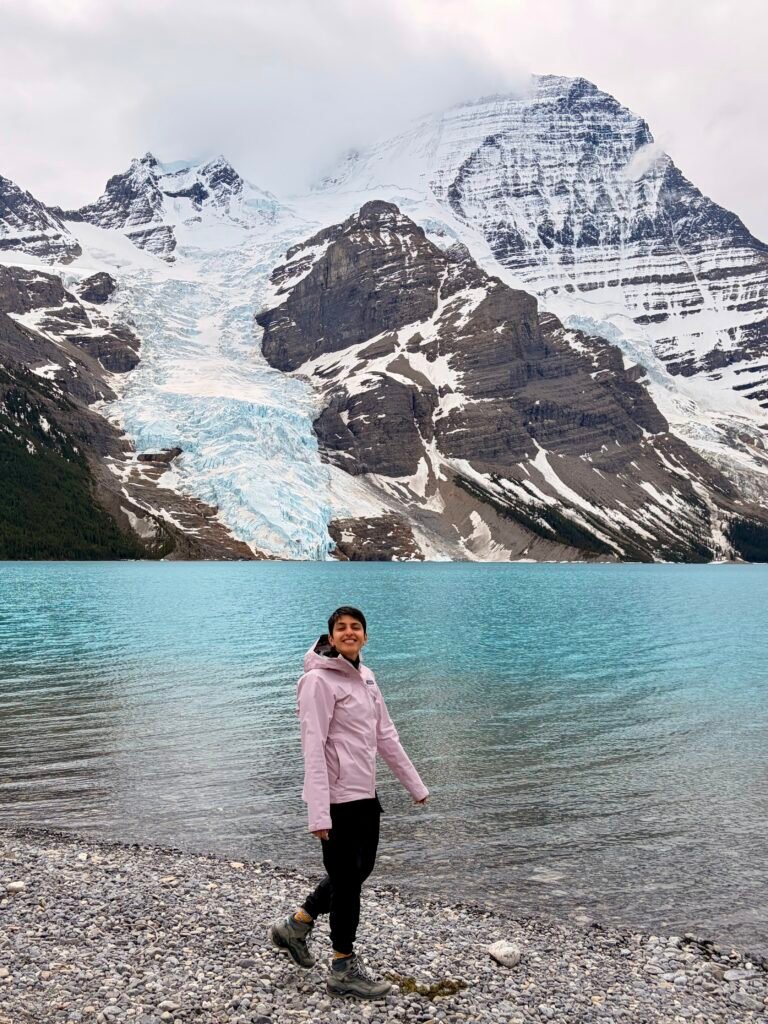
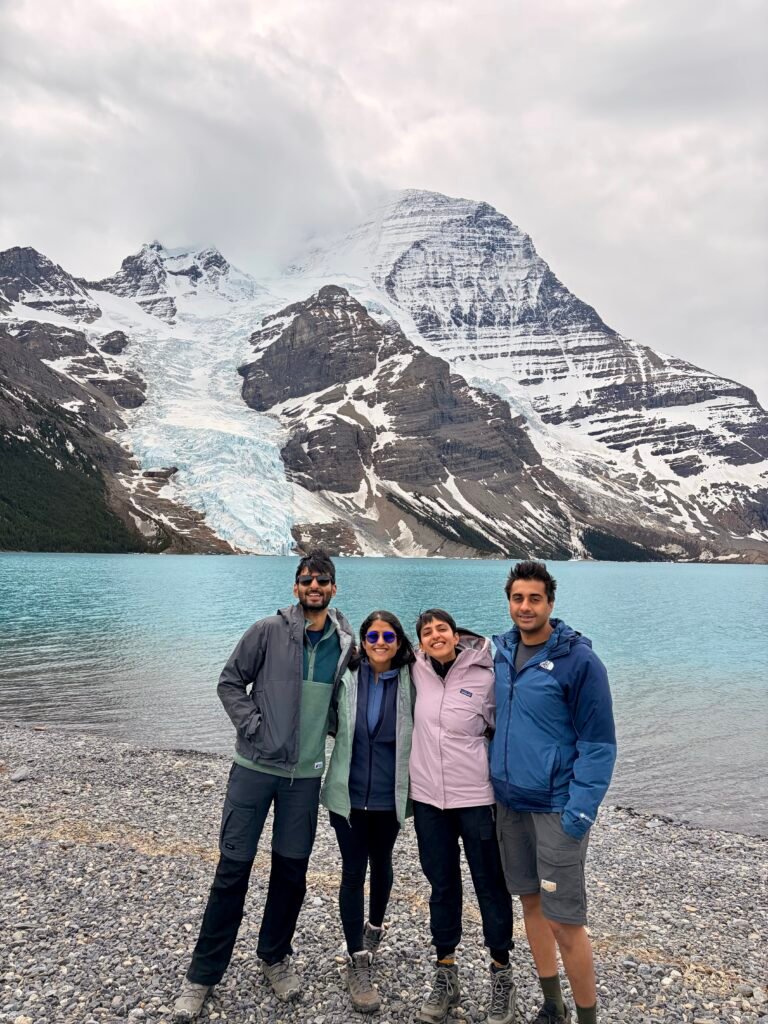
Berg Lake to Robson Pass
Distance: 2km | Elevation: 1,649m at Robson Pass | Time: ~ 1 hour
The final stretch is almost completely flat — a gentle walk through open meadows with expansive views back to Berg Lake, Berg Glacier, and Mount Robson. After everything the trail has thrown at you, it feels like a cool down lap. A good one.
Rearguard Mountain dominates the view as you head north. The landscape here is wide and open, a completely different feel from the dense forest you started in two days ago. Kilometre markers count you down along the way.
Rearguard Campground comes first — just 1km from Berg Lake along this flat trail, accessed via a bridge. Small, quiet, only 6 tent pads. A couple of them have direct glacier views. If Berg Lake is fully booked this is the next best thing, and honestly the size makes it feel more private.
Robson Pass Campground is the final stop right at the end of the Berg Lake Trail. We arrived to find almost the entire place to ourselves, just two other groups. After starting this hike with a forecast of thunderstorms and genuine uncertainty about what we were walking into, that felt pretty good.
15 tent pads, right at the end of the Berg Lake Trail. A big perk was the low crowds here compared to other camping spots.
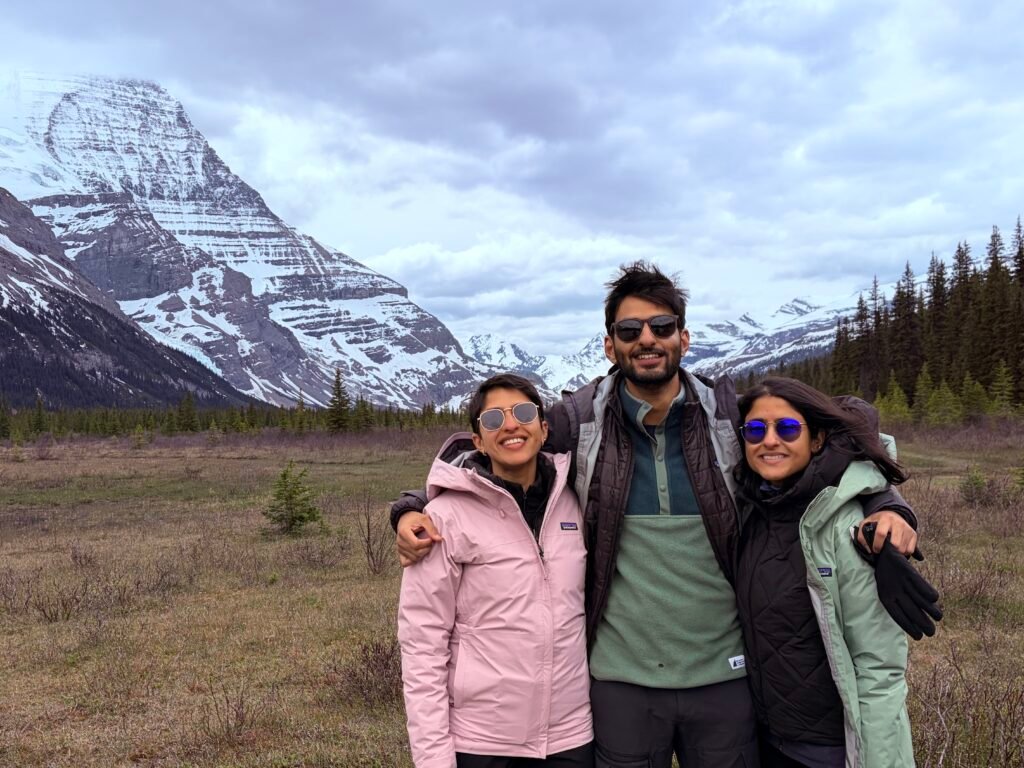
How Many Days Do You Need?
The short answer is a minimum of 3 days, but 4 or 5 is better.
We did it in 3 days of hiking plus a rest day at Robson Pass, and while I don’t regret a single moment of it, I’d add an extra day if I did it again. Not because the trail demands it – but because being in nature for longer is always the right call.
Here’s what we actually did and what I’d recommend instead.
What we did: We went straight from the trailhead to Robson Pass Campground on day one – the full 21.5km in one push. Day two was a rest day at Robson Pass. Day three we hiked back down and camped at Kinney Lake. Day four we walked out.
Is it doable? Yes. Would I recommend it? Not exactly. We did it this way because it was the only booking available. And that’s the reality of this trail – you take what you can get. If Robson Pass on day one is all that’s available, don’t let that stop you from going.
Ideal plan for me:
Day 1: Trailhead to Whitehorn or Emperor Falls Kinney Lake is a beautiful campsite but at 6.5km it’s not enough distance for a full hiking day unless you’re a complete beginner. Push further. Whitehorn at 10.5km is a solid first stop. Emperor Falls at 15km is ambitious but gets the hardest climbing out of the way early.
Day 2: To Berg Lake However you’ve structured day one, make sure day two ends at Berg Lake. This is non-negotiable. The campsite, the views, the glacier – you want as much time here as possible. Arrive, set up, and just sit by the lake for a while.
Day 3: Rest day at Berg Lake Spend a full day here without your pack. Do one of the side hikes from Berg Lake (more on those below), eat lunch in the Hargreaves Shelter, watch the glacier calve. One day just being in nature without an agenda does something good for the brain.
Day 4 onwards: Head back The return covers the same ground in reverse, mostly downhill. You’ll move faster on the way out than you expect.
If you only have 2 days: Some people hike to Berg Lake in one very long day and return the next. Doable if you’re fit and start early, but you won’t get the most out of it.
The thing with this hike is that the permit system often decides your itinerary for you. Plan your ideal trip, but be flexible. Take what you can get and make the most of it, the trail is worth it regardless of how you piece it together.
Best Side Trips & Viewpoints
Full transparency: we didn’t do most of these. Snowbird Pass was closed when we went, and between the hiking days and the rest day, we kept it low key. Some people in our group did Toboggan Falls. I walked to Adolphus Lake. And honestly, the side hikes are one of the main reasons I want to go back.
1. Snowbird Pass
Distance: 20km return from Berg Lake Campground | Elevation gain: ~870m | Time: 6 to 10 hours | Difficulty: Challenging
The most famous day hike in the Berg Lake area and the one I’m most gutted I missed. The trail follows the Robson Glacier before climbing through alpine meadows to the pass itself, with views over the seemingly endless Reef Icefield. There’s also a glacial lake below Robson Glacier filled with icebergs — people actually swim in it.
One important note: Snowbird Pass is closed annually between May 1 and July 1 to protect caribou during calving season. It was closed when we went in late May. If this hike is a priority for you, plan accordingly.
2. Hargreaves Lake Lookout & Toboggan Falls Loop
Distance: 6km loop from Berg Lake Campground | Elevation gain: 340m | Time: 2 to 4 hours | Difficulty: Moderate
Some people in our group did this one and came back raving about it. The loop features cascading waterfalls, elevated views over Berg Lake, a bright teal glacial lake, and views of a second glacier beyond Berg. Based on what I heard, it’s the best bang for your buck day hike in the area. I’ll be doing this one on the return trip.
3. Mumm Basin Loop
Distance: 7.2km from Berg Lake Campground | Elevation gain: 520m | Time: 2.5 to 5 hours | Difficulty: Moderate
An above treeline traverse with views of Berg Lake, Robson Glacier, and Adolphus Lake. There is a partial closure due to landslide damage from 2018 — check current conditions before attempting it.
4. Adolphus Lake
Distance: ~2.5km from Robson Pass Campground | Elevation gain: Minimal | Time: 30 to 45 minutes | Difficulty: Easy
This is the one I actually did. It’s a casual, almost completely flat walk north from Robson Pass along the river. About halfway there you cross the boundary between British Columbia and Alberta – stepping from Mount Robson Provincial Park into Jasper National Park. The border sits right on the Continental Divide, the invisible line that separates Pacific and Arctic watersheds. Standing there felt strangely significant. We met an older couple who had specifically come to see the boundary marker. I didn’t fully understand it at the time but I get it now.
Adolphus Lake itself is shallower and calmer than Berg Lake , not as dramatic, but pretty in its own quieter way. Worth the walk, especially if you have a rest day at Robson Pass.
On the Trail: What You Need to Know
Water
Water sources are plentiful along the entire trail. The Robson River and its tributaries run alongside you for most of the route. We used a filtered water pack that my brother carried as the communal supply. You fill it up, it filters as you drink, and everyone tops up their bottles from it. It worked really well for a group our size. A water filter or purification tablets are non-negotiable though.
Food & Fires
No fires are permitted anywhere on the Berg Lake Trail at any time – not even during periods with no fire ban in effect. Bring a camp stove for cooking. Plan your meals accordingly.
Bear Safety
This is bear country. We carried two cans of bear spray between our group of 11 — each subgroup that split off had one. We didn’t see any bears, and the staff at the Welcome Centre mentioned there had been no sightings in the park so far that season. That said, don’t let that make you complacent. Make noise on the trail, store all food and scented items in the metal caches provided at each campground overnight, and keep a clean camp. The caches are there for a reason.
Wildlife
We saw a moose right after Berg Lake on the return, completely unbothered by us, which is the ideal outcome. Keep your distance from any wildlife you encounter and give them space to move away.
Safety & Communication
There is zero cell service from the moment you leave the trailhead. Tell someone where you’re going and when you expect to be back. A satellite communication device is worth considering for a trip of this length – iPhones now have a built-in satellite SOS feature which most people don’t know about until they need it. The Welcome Centre also has free wi-fi, so use it before you head in.
Weather in the mountains changes fast. Even in July. Pack a rain layer regardless of the forecast.
Thunder Boxes
The outhouses on this trail are more covered and private than most backcountry facilities I’ve used – better than Killarney or Algonquin, for what it’s worth. No toilet paper provided at any campground. Bring your own and pack it out.
What’s in My Backpack
I packed smarter for this trip than any hike I’ve done before. It showed – especially on the Whitehorn to Emperor Falls climb where every unnecessary gram counts.
For a full breakdown of what I carry on multi-day backpacking trips, head to my ultralight backpacking gear guide. I also have an Amazon shop with everything I’d recommend for a hike like this.
My Honest Experience Hiking Mount Robson
I’ve done a lot of hikes where you spend hours grinding through unremarkable terrain to reach one good viewpoint at the top. Berg Lake is not that hike.
The effort-to-reward ratio here is unlike anything I’ve experienced. It’s beautiful from the first kilometre and it just keeps getting better. There wasn’t a single moment on this trail that felt like something to push through. Every section had something – the cedar forest along the Robson River, the Valley of a Thousand Falls opening up from Whitehorn, the rainbow at White Falls, Emperor Falls misting you from 10 metres away, and then Berg Lake itself appearing at the end of it all like the trail saved its best card for last.
My favourite moment was sitting at Berg Lake. We’d been hiking for hours, we were tired, we had an hour left to camp – and we just stopped and sat on the benches by the shore for a full hour. Nobody complained. Nobody rushed. The glacier was right there, the lake was that impossible shade of turquoise, and 11 people who had flown in from different corners of the world were just sitting quietly together.
The hardest section is Whitehorn to Emperor Falls — no question. The switchbacks are relentless and the terrain gets rocky and rooty. But it wasn’t as hard as I was expecting, and I think that’s worth saying honestly. I had put some work into my cardio beforehand and packed lighter than usual. Both of those things made a real difference. If you’re planning this hike, invest in both.
Was it worth it? It’s one of the best hikes I’ve done in Canada. And I’ve done a few.
If you’re building a Canadian backpacking bucket list, the Long Range Traverse in Newfoundland is my other favourite. Different in every way – coastal, remote, and genuinely wild – but the same kind of hike that stays with you.
